Redhouse and the Portuguese

If you read the first episode of this saga, you will remember our man !Click, who may have been done to death by the Phoenicians. Surely, the sceptic asks, isn’t it far more likely that the Khoikhoi did him in? After all, the former hung about for a couple of months, whereas the latter had fifteen hundred years in which to lose their cool with !Click.

I don’t think so. If there had been an altercation, the victorious Khoikhoi would have been left in possession of their encampment on the site of the future ZRC bowling green, the San would have fled, and the victors would have chucked !Click’s body into the River to get rid of the evidence, a custom I can tell you is honoured to this day.

Back to the first millennium of the Christian era. While Europe lived through its dreadful Dark Age, the happy fellows down south continued their blissful existence in the sun, generation after generation, pass the Karri, no worries mate, as those aboriginals say on that hot continent this side of New Zealand.

Eventually, someone turned the lights on, and the Dark Ages passed. What kickstarted the process, in my humble opinion, was the balance of trade. The people of Europe, whose main contribution to civilization for the past many hundred years had been constant warfare and the odd magnificent cathedral, became aware that the people to the east of them enjoyed a much higher standard of living.

Everything they heard from the ships arriving from the Eastern Mediterranean sounded too good to be true. Fine clothes, smart houses, exotic foods, a wide variety of wines, the list went on and on.

They wanted some too. But how to pay for it?

Picture the scene. The lady of the manor, barefoot and possibly pregnant in the kitchen, such as it is, dressed in a sackcloth nightie (I am not sure what sackcloth is, but it sounds suitably unfashionable), is unhappy.

She has heard about the wonders of the East and how comfortable life is in Baghdad for highborn ladies. It’s time for change, she decides.

At this moment, in staggers the Lord of the Manor, having just sent a couple of unruly serfs to everlasting hell and damnation. He is accompanied by his young squire and two burly men-at-arms, Tom and Bert.

She lets the sackcloth slip off the shoulder  exposing rather more skin than a young squire should see, causing his youthful eyes to open very wide indeed.

“Darling, I want to talk to you alone”, says she, in the sultriest of Norman French tones.

Now you must remember his Lordship is wearing full armour. This consists of a surprisingly large number of separate items. This guy is wearing enough steel to stock a small automotive component manufacturing plant.

It’s easy to lift the large helmet off his sweaty head and toss it aside. But then we have the gorget (neck guard), spaulders (shoulder guards), vambraces and gauntlets (arms and hands), cuirass pieces (chest and back), cuisses, poleyns and greaves (thighs, knees and shins) and sollerets (segmented feet guards).

While his henchmen work frantically to dismantle the metal assembly, the Baron’s lusty gaze never leaves his delectable wife. If you have ever seen a bull elephant in must, you can imagine the heat of the moment.

“Hey, Bert, pass that number 15 spanner!” shouts Tom.

“Ok, but I need the Phillips screwdriver” replies Bert.

Just one item left and then she’s in for it.

“Dog’s bollocks!” wails Bert “we didn’t bring the Allan keys for his codpiece!”

Let’s leave that there.

The message was clear. You want nice, then produce the silk and spice! So now you understand that the sudden emergence of Europe from the Dark Ages was based on nothing more than feminine retail therapy.

In order to pay for these goodies, gold was required. There wasn’t a lot in Europe, but there was a steady supply coming across the Sahara via camel train from deepest, darkest Africa.

This bullion was handled by the Ottoman states ranged across the coast of North Africa. But, as Christian Europe was perpetually at war with the Muslims, not much gold crossed the Mediterranean Sea.

Enter Portugal. Specifically King John I and his English bride, Queen Philippa, elder sister of King Henry IV of England.

Portugal and England are joint signatories to a treaty signed in 1373, which has never been revoked. For nearly six hundred and fifty years, they have been allies in numerous wars. This longstanding friendship is no doubt strongly reinforced by the English passion for Vinho do Porto.

The royal couple produced a fine batch of princes, called the “Illustrious Generation“. These guys led Portugal into its famous age of discovery.

One of them was Prince Henry the Navigator. He masterminded the slow but steady exploration of the west African coast and its offshore islands, the Canaries, Madeira and the Azores. The objective was to find the source of that African gold.

In 1412 he ordered an expedition to sail down the coast of Africa. From that time on, every couple of years, the Portuguese explorers reached a new point further south. In 1471 they crossed the Equator. The southern hemisphere was discovered, and they started using the Southern Cross for night time navigation.

Finally, in 1488, after fifty years of methodical exploration, Bartolomeu Diaz and his reluctant crew beat into a south westerly breeze, losing sight of land. They turned east, and when no land appeared, they altered course to port and eventually spotted the coast just west of present day Mossel Bay. The Khoikhoi clan in residence took one look at this apparition on the sea and fled inland with their cattle.

Diaz sailed into Mossel Bay. The sailors landed, found fresh water and began to fill their barrels. The locals didn’t run away, but they were clearly unhappy. Eventually they began to throw stones. Standard South African protest action. Grabbing a crossbow, Dias shot one of them dead, causing the protestors to flee in terror. Standard South African security force reaction.

Thus, this initial contact between the first Europeans to reach southern Africa and the Khoikhoi resident in the future Mossel Bay was to set the scene for the next several hundred years.

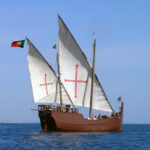
Over the years of exploration, the Portuguese had constantly improved their ships. Still, Senhor Diaz’s caravels would probably not be allowed at sea if governed by modern day South African rules, generated by that dubious organization, SAMSA, whose mission statement appears to be “if it floats, tax it!”.

In 1988, a replica caravel was sailed from Portugal to South Africa, eventually ending up in a museum in Mossel Bay. It visited Port Elizabeth and I attended a cocktail party on board. Attending cocktail parties on ships was a favourite pastime in those days.

In spite of the flush loo, modern navigational equipment and a sturdy diesel engine, the captain said he would be most reluctant to sail her up the Wild Coast.

Five hundred years before, Bartolomeu and crew sailed eastward and entered what we now call Algoa Bay. They anchored in the lee of an island they named Islet of the Cross, now called St Croix, upon which they erected, of course, a wooden cross.

Diaz had started the voyage with four black female slaves, who had been abducted from somewhere on the west coast of Africa by a previous expedition, taught the language and educated in Christianity. The plan was to drop them off at various places where they would teach the local inhabitants about the glories of Portugal.

One died at sea, two got dropped off somewhere on the west coast, and the last was marooned on the shores of Algoa Bay, near some Strandlopers collecting shellfish. What did they expect would happen to this poor soul? Needless to say, that’s the last we hear of her.

At this point, let me tell you that the Portuguese sailed backwards and forwards past the coast of South Africa forever, without showing the slightest interest in going ashore unless they really had to.

So uninterested were they in the country, it took them until 1575 to produce the first chart of the South African coastline.

They regarded the place as a wilderness and the inhabitants as bloody dangerous, understandably so as they lost the Battle of Salt River by badly underestimating the fighting ability of the local Khoikhoi tribe, the Gorinhaiqua.

On his way home from India in 1510, the notorious Francisco D’Almeida, an experienced soldier with a brutal reputation, stopped off at the Cape for water. He decided to attack the Gorinhaiqua encampment and attempted to take cattle, women and children.

In their arrogance, the Portuguese didn’t  bother with firearms. But their swords were no match for the Khoikhoi spears, let alone their war cattle, which were trained to respond to their masters’ whistles. The cattle completed the rout. D’Almeida and over fifty sailors died.

A few years back, a severe storm exposed a mass grave near Woodstock. Archaeologists identified D’Ameida’s bones. First round to the Khoikhoi.

Over the centuries, Portuguese ships must have stopped off in Algoa Bay to replenish their water casks. But there is no evidence that they ever sailed very far up the River.

I am sure that if the grounds of the ZRC were dug up, plenty of empty port bottles would be discovered, but they wouldn’t have come from a caravel.

The Khoikhoi settlement on the banks of the River was no more. They had moved on. !Click rested in his grave. All was quiet.

The future site of Redhouse was deserted. Nothing was heard but the lapping of the water against the banks, the lovely call of the fish eagle, and of course, the maddening chitter-chitter of the verdomde egrets!

Talking about charts, if you look at websites dedicated to Algoa Bay and Port Elizabeth, you will see that some of them include a map. It states that it is a late seventeenth century chart of Algoa Bay.

I magnified it and it didn’t look right to me, so I investigated further. It turned out to be a Dutch East India Company chart of Delagoa Bay! Nice one, web site designers!

Wondering where all our tourists went? Try Maputo!
Redhouse and the Ancestors

In the last blog, we flashed through 125 000 years of exciting events in three pages. I will try to slacken the pace.

We discussed the possibility of the Phoenicians visiting the Swartkops River, and the panic this must have caused amongst the little band of Bushmen resident in our future Village.

By the Year Dot, approximately 24 generations after this dramatic event, the indigenous population had forgotten all about the Phoenicians and had resumed the even  tenor of their ways. Incidentally, there never was a Year Dot. The early monks who dreamt up the Anno Domini method of counting years had no concept of zero, so they went straight from 1BC to 1AD.

Life was chilled. As long as you avoided annoying the elephants, rhinos, hippos, lions, leopards and buffalo, and didn’t tread on a wide variety of reptiles, you could happily spend all day long eating oysters off the rocks. No champagne unfortunately, but they did drink Karri, a fermented honey mead.

According to legend, they discovered a hollow tree containing a small pool of water, into which honey had dripped from a hive above. It had fermented naturally. When they got over their hangovers, this seemed like a brilliant idea. In due course, different varieties of Karri became available, depending upon the flavour of the local honey, which of course depended upon which flowers the bees visited.

But this idyllic lifestyle was too good to last. People now termed Khoikhoi but who called themselves the Red People, decided to leave Botswana and head south.  Two thousand years ago they reached the sea.

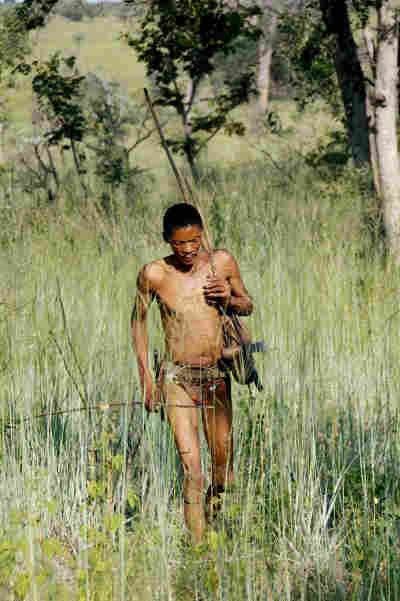
Genetically, the Khoi and the San were related. Linguistically both relied on lots of clicks. Genetic studies indicate that 22 000 years ago the Khoisan constituted the largest group of hunter-gatherers on the planet. The San are the descendants of the first Homo sapiens, i.e. modern man. They have the oldest gene pattern of any existing people and it is thought that all other nationalities are descended from them.

But there was still a serious cultural distance between them. The Khoi looked down upon the Bushmen – the name San they gave them means “those who pick things up from the ground”.

The Khoi brought with them cattle and sheep, seriously displeasing personal habits and a bad attitude. They smeared animal fat over their bodies to exhibit their wealth. The richer, the smellier.

The concept of personal property was part of Khoi culture, those with large herds were the rich people, those without worked as servants. Whereas the San were the original socialists. Nobody owned anything of note. And if hungry, they felt zip about pinching a Khoi cow.

Despite divergent lifestyles, the Khoi and the San coexisted and probably interbred once they got to know each other.

Of course, the Khoisan formed the bedrock of the Coloured folk of South Africa. The numerous “click” languages were lost except within those remnants of the San people still found in areas of BotswanaNamibiaSouth AfricaAngolaZambiaZimbabwe and Lesotho. They were replaced by a version of Afrikaans which has to be the most expressive in the country.

It is well known that the Eastern Cape is the home of Black and Coloured rugby. Some clubs have been in existence for over 100 years. I have been to plenty of games in my role as driver of the referee’s getaway car. The ref being Michael, my son. We have been to places I didn’t know existed. You have no idea how popular rugby is out in the bundu!

Imagine the scene at a typical derby between two Coloured teams if the click language had prevailed.

The original is followed by the Afrikaans equivalent, and then the English translation.

The referee to the scrum: “Clack, click, clock” (“Crouch, Bind, Set”).

The spectators, advising the referee:  

“Clickity-click”, clickity-click” (”Hy hou! hy hou”). [“He won’t release the ball!”]

“Cluckity cluck!” (“Hy’s omkant! Hy’s omkant!”) [“That player is offside!”]

“Clockity clockity cluck” (“Jy blaas soos ‘n doos!”) [“You are not reffing very well!”]

“Clackity, clickity, clockity cluck! (“Vat jou fokken oë uit jou gat uit!”) [“We advise you to observe the game more closely!”]

Let me come back to the straight and narrow.

For the original inhabitants this was the first of many more intruders yet to come, of which more later.

It is very likely that a Khoikhoi clan took up residence at the site of the future Redhouse. They set up their huts and grew some crops. They didn’t move around as much as the San. They had clay pots  in which they stored food and Karri.

They lived in clans on what they considered their tribal territory. Every so often, they would decamp and move to another spot, perhaps in pursuit of grazing for their cattle.

Now, what earthly reason do I have for thinking that the Khoikhoi once lived in Redhouse, you may well ask.

Firstly, their descendants are still traversing the Village with their cattle, fertilising our greenery as they go!

Secondly, it is well known that Redhouse has been the home of hordes of egrets for ever and ever. Every trick in the book has been tried to get the egrets to leave the Village for as long as I can remember. Nets over the trees in which they live. Toy snakes placed strategically on the branches. Loud bangs. Shotgun blasts. Nothing will make them go away.

There are many kinds of egrets, but I guess ours are Bubulcus.Ibis. In Latin, Bubulcus means cowherd. These egrets like ticks. I reckon this is their ancestral home, harking back to the days of Khoi and their cattle. We are doomed to live forever with the incredible mess they make, not to mention the smell.

So what made the Khoi up sticks and head south? It so happens that even further north there was a great stirring.

Probably due to a rise in population, a slow but steady exodus of people began, moving eastwards and southwards out of the area where Cameroon is today, from about 3000BC.

It took them a while but in due course the first of the so-called Nguni speakers arrived in Northern Natal. It wasn’t so much an invasion as a slow advance into new lands looking for fertile soil to plant their crops and water for their cattle.

As the centuries passed, these people comprising several tribal groups collectively called the AmaXhosa, and behind them many more tribes now lumped together as the AmaZulu, gradually filled up the east coast of South Africa.

Their encounters with the San and the Khoikhoi they found in their path cannot have been all that unfriendly. They absorbed some of them into their ranks which is why their language, isiXhosa, contains a few of the original San clicks. Nelson Mandela was of the royal house of the abaThembu, and his DNA test showed that he had Khoisan ancestry.

This gradual southward movement and social interaction between the San, the Khoikhoi and the advancing black tribes was a pretty laidback expedition. Bear in mind that they first entered northern Natal around  1AD, and it took until 800AD before the vanguard made it to the Fish River.

Let’s call it about 1000 km from the northern border of KZN to the Fish River. That’s an average trek of 1.25 kilometres per annum. Even our decrepit railway system moves faster than that!

Several more waves of immigrants followed and by 1500AD the land east of the Fish was well settled.

Elsewhere in the world a huge amount was going on.  During that 1500-year period, in Asia, Europe and the Americas, numerous empires rose and fell, major religions emerged for better or for worse, dreadful plagues swept the world from time to time, millions upon millions of people were wiped out by warfare, the Dark Ages descended, China invented paper and gunpowder, eventually the Renaissance enlightened the dismal scene, America got “discovered” and, more importantly for this romantic series, Vasco da Gama made it round the Cape to India.

Where would you have rather been 1000 years ago? Merry England, or the Eastern Cape? Read on!

If you are of European descent, and you could go back 40 generations in your time machine to visit your ancestor, the chances are that you would be absolutely appalled at what you found.

Let’s assume a man of middle age (in those days probably between 35 and 40). By the law of averages he would have been a serf, bound to his master’s land for life. Do you really think you are directly descended from William the Conqueror?

Being a serf meant that his daily grind was dictated by the local baron, who could do with him and his family as he wished. This included handing over his daughter to his lordship on the eve of her wedding day, the so-called droit du seigneur!

When you introduced yourself, shivering in the pouring rain of a typical English summer, he might have opened his gob to reply, and you would have been greeted with a mouthful of broken and missing teeth, seriously bad breath and a hacking cough brought on by the latest bout of plague.

You wouldn’t have been able to refuse his invitation to enter his odorous cottage, made of mud and timber and a thatched roof, with a fireplace in the middle of the single room. Don’t shriek if you see a rat and, yes, that itching really is a horde of fleas.

And  please don’t ask to go to the toilet!

However, if your great, great, plenty more greats, grandfather was part of the long, slow migration of the amaXhosa, well, what a pleasure. Hey ho, up at dawn to check on the cattle. That was the man’s job, and he was also in charge of making the Amasi, fermented milk, like yoghurt.

After that was done, and the women were busy tending the crops, making food, looking after children, skinnering and all the  other tasks they constantly  complain about, well, sit down with the amadoda and discuss affairs of state.

And if the urge is upon you, take a stroll a little way up the nearest kopje, check that no ill-intentioned serpent is lurking in the grass, crouch on your haunches, give thanks for the lovely view of rolling green hills dotted with your fat cattle, the lazy brown river flowing past your kraal, the bluest of skies, and enjoy what is so well described in that most earthy language, Afrikaans, a hearty boskak!

Redhouse BC

Dusk, the autumn sky pink and grey, and the braai fire well on the way down at the River. Where better  to contemplate the Coronavirus and lockdown?

As I have been more or less confined to barracks for six weeks following knee replacement surgery, I am well used to isolation. On my tod with just dogs and bottles for company.

The first thing you notice is that life is not as hectic as before. You realise how much time is taken up with driving to town, working out at the gym, going to the pub, visiting family and friends and so on.

So what to do with all these extra hours? And then it struck me that I have always wanted to write but was always too busy to get into the swing of it.

Now I have no excuse! Engage right brain and get to work!

So this is the first of a series of blogs about the Village of Redhouse. It is not necessarily a true history, because truth is an elusive thing, and sometimes I make things up.

For those imaginary readers who may never have heard of Redhouse, you will find it on the banks of the Swartkops River, 20 km north of Port Elizabeth, which is the loveliest city in South Africa, if one excludes the City Council.

It makes sense to start the story at the earliest time when humans (well, sort of) may have lived in the Village.

Not very far away, in the caves at Klasies River Mouth near Humansdorp, about 125 000 years ago there lived some people who, according to the boffins, may have been anatomically modern but not necessarily “behaviourally” so, unlike the next lot to move in 50 000 years later.

The first mob apparently trampled the garbage underfoot in the caves, whereas the later arrivals made a point of dumping it outside. Upon this evidence the scientists calculate the degree of civilization.

Evolution does strange things. Sometime during the approximately 2000 generations between the two sets of tenants, a mutation occurred in the female DNA. One day, Mrs Klasie just had enough of this tramping dirt into the carpet and threw her toys out of the cot. As the mutation took hold, so did the volume of screaming, shouting and nagging.

You would think that natural selection would have favoured those females less noisy, given that males prefer some intervals of peace and quiet.

My theory is that it worked the other way round. Males realised that they got to escape the cave to take the garbage to the midden. Once they were out, they could skive off to see their mates and have a Middle Palaeolithic beer.

However, let’s move forward in our time machine and position it above the spot where a long time in the future the Village would arise. We are now at about 18 000BC.

I don’t think the River flowed in its current position then. Rivers change over time, sometimes rapidly. It’s reasonable to think of its main course running along the foot of the escarpment opposite the Village in those days.  

And it wasn’t a tidal river, at least not at Redhouse.  The sea was 125m lower than at present. The weather was about 6 degrees colder on average than today.

This means that the shoreline would have been way beyond the latitude of Bird Island, then just a kopje in the veldt.

The reason for this astonishingly low sea level is called the Last Glacial Maximum. Here we shall have a digression into the suddenly forgotten topic of conversation, Global Climate Change.

You will be pleased to know that we are living through the splendidly named Quaternary Glaciation, which started a mere 2.58 million years ago, and was preceded by at least another four glaciations.

During this time, the planet has endured cycles of cooling and warming, on average 100 000 years of chill and 40 000 years of bikini weather.  The Last Glacial Period began about 115 000 before the present and reached its maximum about 22 000 years ago. The amount of water locked up in the ice sheets around the world caused the sea level to drop dramatically.

Then it slowly began to warm up, although there have been periodic relapses of varying severity from time to time.

For example, the River Thames used to freeze quite frequently. The citizens would hold Frost Fairs on the ice. The first on record was in 695 AD. The last one was in 1814.

Great fun was had by all. 1683 was a particularly cold spell. The River froze from 20th December until 6th February, during which time a whole street of shops was established, coaches plied the “streets”, much sport was enjoyed, including bull-baiting, and small boys played football on the ice.

On 2nd February (Candlemas day) they roasted an ox. King Charles II and his Queen came to the braai.

Sometimes, the ice melted rather too fast. In 1789, a ship anchored to a pub next to the River sank down as the ice melted, pulling down the pub and crushing five tipplers to death.

End of digression. Back to the Swartkops River.

Now we are getting closer. By 3000 years ago the sea level had stabilized at more or less its present height and didn’t alter by more than 0.2mm per annum until about 1880, when it started to climb to an average of 1.8mm pa. No doubt due to the industrial revolution burning a prodigious amount of coal.

Who lived in the Swartkops valley then? No doubt wondrous herds of game, aardvarks and antelope, heffalumps and hippos, lions and leopards, San and their cousins, the Strandlopers.

We now need to shift our focus northwards, to Ancient Egypt, where reigned from 610BC to 595BC Pharaoh Necho II, an ambitious fellow who, amongst many other projects, made the first but unsuccessful attempt at building the Suez Canal to foster trade between the Mediterranean Sea and the Indian Ocean.

He also managed to get a mention in the Bible for killing King Josiah of Judah at a battle at Megiddo in 609BC.

Most importantly for our story, he sent Phoenicians around Libya (as Africa was called in those days) from east to west.

The Greek historian, Herodotus, said it took them three years before they returned through the Pillars of Hercules (Straits of Gibraltar).

He personally doubted the story as they said the sun rose to the north of them, which of course would have seemed strange to someone living in the northern hemisphere.

Many years ago, I was told by a very wise old amateur archaeologist that there was a strong possibility that the Phoenicians wintered over in the Swartkops River valley. There would have been plenty of fresh water, game and salt.  A beautiful place to chill for the winter.

It makes lots of sense. The Swartkops River would have been deep and wide and unobstructed by the dreadful bridges that have caused it so much damage over the last 150 years. They would have sailed in through the mouth with a fresh south easterly on the port quarter and proceeded upstream until they found a fairly flat piece of shoreline (where the Redhouse Yacht Club is situated) before dropping anchor.

The other reason to stop at that point might have been the presence of a San community close by. The reason for surmising this is the presence of one !Click (well, he has to have a name) found buried in a sitting position six years ago, with a hole in his head, not far from this landing place.

There may well have been a San encampment where the famous Zwartkops Rowing Club (ZRC) is situated on slightly higher ground, just above the probable landing point.

You can imagine the scene. The San are sitting around digging up grubs for lunch, they look up and suddenly see this large boat, an apparition totally strange to them. They would have been transfixed in astonishment!

Apparently, the San use as many as twenty different click sounds when they talk. The excited conversation about this entirely new experience in their lives must have sounded like a knitting machine convention.

Then a large fellow shouts at them in a strange language – all he wanted was a cold beer – and they take to their heels in fright, whereupon the thirsty one shoots an arrow after them and down goes !Click!

Or perhaps !Click belongs to a later era. We shall see as this series unfolds.

It’s interesting to speculate on the type of ship the Phoenicians might have used for his expedition. They probably wouldn’t have used one of their long, narrow warships fitted with a bronze ram, which would have been a bit scary to sail in the open ocean.

They had big cargo vessels called Gauloi, which were wider than the warships and had curved and rounded bows and sterns and would have been easier to handle in a swell. They had one massive mainsail and probably weren’t all that fast. They had a steering oar rather than a fixed rudder.

The  helmsmen must have been pretty fit fellows!

They would have had no problem sailing such a ship up the Swartkops River. It had a decent depth of water in those days.

The fishing must have been magnificent. Add in natural salt pans, plenty of fresh water and loads of game to hunt.

In 1907 the bowling green next door to the ZRC used to be Mr Stead’s orchard. Perhaps this was where the Phoenicians grew their fruit and veg.

I have long wondered whether there are any Phoenician artefacts lurking about.

There is a large silver, three-handled mug with a glass bottom at the ZRC, of unknown provenance, much used in the past for drinking Black Velvet (Guinness and Champagne) and sometimes for decorating the ceiling with same. But sadly I think it belongs to the time of Queen Victoria.

Now that the Club is deserted due to lockdown, and all Villagers are obeying orders and are out of sight at home, this might be the time to dig up the bowling green in search of relics!

Finally, enjoy the lockdown and please refrain from uxoricide!