Redhouse and the Republic

1960 was not the happiest year in SA. In January, riots in Durban killed a number of policemen. In February, rebellion against the government erupted in Pondoland, and in March the infamous Sharpeville Massacre took place. British Prime Minister Harold MacMillan made his memorable “Winds of Change” speech in the South African Parliament. 17 African countries gained independence that year.

On a happier note, the Beatles formed up in Liverpool and the birth control pill became commercially available. The world population was a tad over three billion.

In 1961, the Union morphed into the Republic and left the Commonwealth. This move was much welcomed by most Afrikaners, not so much the by the English-speaking population. The Black population may not have been too happy either, despite having endured one and a half centuries of British rule. I remember my old nanny, tears rolling down her cheeks, saying “They have taken our Queen away”.

Almost immediately, international pressure was exerted. South Africa was banned from the Olympic games. Within the country, apartheid was rigidly enforced, and the black liberation movements responded. Decades of mayhem followed.

Yuri Gargarin  made the first human spaceflight. A Russian dog, Laika, had preceded him by four years.

In 1962, the world teetered on the brink of nuclear war, but President John F Kennedy faced down the Soviets as their fleet loaded with missiles headed towards Cuba, and we all breathed a big sigh of relief. Imagine a similar situation with Donald Trump in charge!

In 1964, Nelson Mandela was sentenced to life imprisonment, the Rhodesian Bush War began, and the author completed school without being expelled.

In 1965 Hendrik Verwoerd was assassinated in Parliament, Sir Winston Churchill died, and yours truly was conscripted into the Army for an interesting nine months. Looking back at the experience, it’s amazing how time effaces pain in favour of fun!

I do recall the suffering involved when I had to “skaapdra” a large  fellow who was a postman in civvy life, up the butts at the shooting range at Hamilton in Bloemfontein. This punishment came about because the staff-sergeant instructing us in radio procedure left the classroom for thirty minutes.

In that time, we logged into the police channel and began reporting burglaries and murders all over. The cop vans went ballistic. But our staff sergeant was wise to us. “Julle is nou weer in die kak!”

Tempe was a not a holiday camp. But the Army does some strange things. Some of us entrained for Cape Town for six weeks of guard duty. We were garrisoned in the Castle, where we were served very decent food on crockery by waiters.  What a change from the normal greasy horrors dumped into your ”varkpan”!

Our job was to guard Wingfield Airfield. At that stage there didn’t appear to be any other army presence in Cape Town, just those nancy boys in white ice-cream outfits who had landed with their bums in the navy butter. So armoured troops guarded an air force base under command of the navy. Weird.

One evening, while off duty in our guardhouse at the airfield, we had attempted to persuade the above-mentioned postman to part with some of his biscuits, but he was not budging. We made a plan.

While my mates kept him talking, I leopard-crawled up behind his bed, the idea being to remove the packet of biscuits from his pack. But I guess postmen have instincts honed by constant confrontation with angry dogs. He sensed my presence and used his large boot to good effect on my head. A brawl ensued. Eventually peace descended, the biscuits were eaten, and we all went to sleep, except the postman who sulked outside in the freezing winter rain, nursing his bleeding face.

I was rudely awoken by a naval petty-officer and after parade in the Castle courtyard the next morning, was brought before the Veldkornet (they had reverted to Dutch East India ranks at that stage). The postman and the corporal of the guard, a middle-aged man of limited intelligence, then laid their charges against me.

Apart from assault, battery, and biscuit theft, I was indicted for deliberately riding the corporal’s bicycle into a wall with resultant damage and of running and jumping on eight army beds until they broke. What saved my bacon was the lugubrious manner in which the two complainants laid their charges. I could see the Veldkornet biting his lip to stop himself laughing. I got off with confinement to barracks.

A year later, the 24-year long Border War started. It ended in 1990 with the approach of democracy for Namibia and South Africa, and the collapse of the Soviet Union. It had evolved from an “anti-terrorist” movement into a proxy war between the West and the Communists.  Over 2 000 South Africans and at least eight times as many Cubans, Angolans and Namibians lost their lives.

By this time, the USA was embroiled in the unpopular Vietnam War. In 1967, the Israelis whacked four Arab countries in the Six Day War even though vastly outnumbered. Dr Christiaan Barnard carried out the world’s first heart transplant.

In 1968 President Kennedy and Martin Luther King were assassinated. I was back in the Army for a three-week camp, on manoeuvres in the Free State. My buddy and I decided to charge a large anthill in our Ferret scout car, a lovely four-ton toy with a six-cylinder Rolls-Royce engine. The anthill won. We ended up with all four wheels off the ground and spent some time wondering how we would explain this problem. Luckily some friendly “tiffies” came by in their engineer’s truck and pulled us off.

The first moon landing took place on July 20, 1969. I remember watching the full moon. The computer processor on board the Apollo spacecraft ran at 0.043 MHz.  A modern Apple cell phone runs at  2490 MHz! Woodstock happened, and Redstock, the Village version, carries on the tradition.

In September, the Tulbagh Earthquake, 6.3 on the Richter Scale, occurred during the night. I distinctly remember waking up as my bed shuddered and thinking to myself that I should perhaps consider spending less time at the Club. But the next morning there was a crack in the opposite wall.

The decade of the ‘60s saw big changes in the Village. Previously run by the Divisional Council, Redhouse became part of the PE Municipality. The cattle grid and old farm gate at the village entrance were removed. Streetlights became a hotly debated topic. The old manual telephone exchange housed in the then functioning post office opposite the station disappeared in the early 1970’s.

In those days, many people from the Village travelled by rail, including  kids going to school in town or Uitenhage. We had a lot of fun on those old trains. Eventually, steam faded from the scene and now we endure diesel locos, with their banshee wail, about as romantic as a mobile brick.

The 1970s was the era of sexual revolution which lead to free and easy attitudes about mankind’s oldest game, but the backlash came at the end of the decade with the rise of AIDS. Feminism continued to fight for women’s rights.

Round about 1970, primary salt pans were established across the River from Redhouse and to the north where the golf course used to be. There was a major outcry about this as residents declared that salt seepage would kill all vegetation. It is true that the Golf Club gave up the ghost in 1978 but that was as much to do with the movement of serious golfers to much more attractive courses in town, and the removal of George Goba and his family from the area by the application of apartheid law. George had looked after the course for ages.

For nearly half a century the pans attracted thousands of birds and created the basis for a future tourism industry in the area. Unfortunately, the advent of democracy in 1994 also ushered in the era of kleptocracy, whereby the ruling party abandons all responsibility for governance in pursuit of looting the state. The pans are now salt deserts, and there are no more flamingos, entirely due to the incompetence of local government.

In 1970, the world population hit 3.7 billion and the Boeing 747 made its maiden flight. Bigger aircraft were needed!

In 1971, the microchip was invented, a significant step in the progress of computerization. In a throwback to the stone age, Ide Amin seized power in Uganda. A murderous nutcase if ever there was one, old Idi demonstrated that democracy has an inherent weakness in that it relies on the popular vote. Most voters make decisions based on emotion rather than logic. The end result is not always a happy ending. Look at the modern USA ,and SA for the last twenty-six years.

The yachting scene at Redhouse was booming. So was the South African economy but not too many could see the long decline that lay ahead.

In August, the River came down in flood.  Alan Scott’s houseboat was moored in the River and he set off his alarm to awaken the Village at 04h00. I had returned the previous night from a six-week stay in Frere Hospital in East London, following an unexpected encounter with a bakery van in the middle of the night while on a  hockey tour. The alarm woke me up.

The water was extremely cold. Numerous large serpents lay washed up on the Towpath, alive but immobile, their cold-blooded metabolisms no match for the conditions.

In 1972, Northern Ireland suffered the Bloody Sunday massacre and the Summer Olympics in Munich were disrupted by the murder of eleven Israelis by a Palestinian terrorist group. A South African Special Forces team carried out a raid on the Tanzanian port of Dar es Salaam using as their base the SAS Emily Hobhouse, a Daphne class submarine.

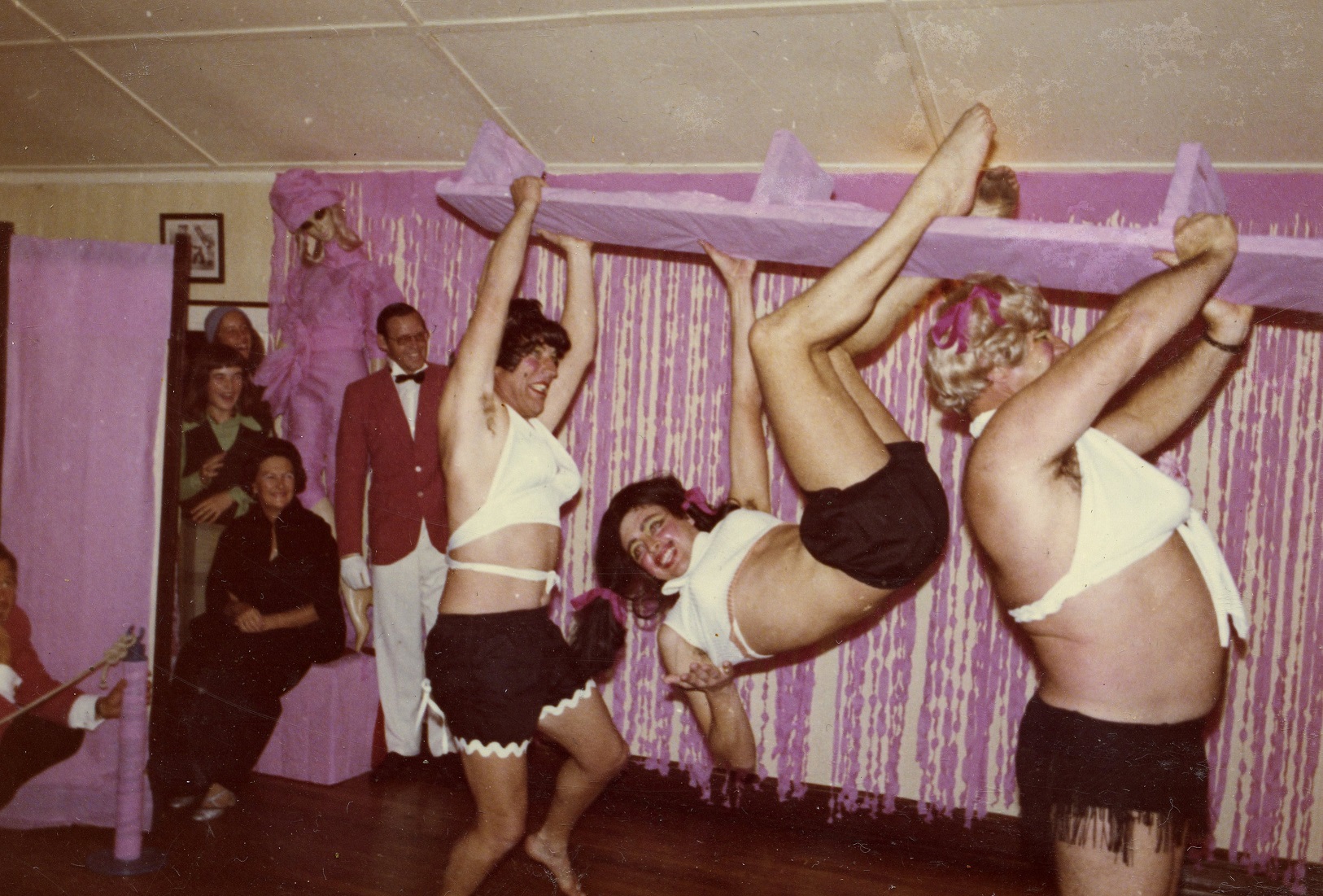
1973 was a BIG year in Redhouse. The Zwartkops Rowing Club celebrated its centenary with a well-planned series of events, including the reintroduction of rowing as a regular sport, culminating in a huge party entitled “Dancing through the Ages”, see picture. Most amazing fun. In December, senior yachting personality Alec Paterson introduced the Laser dinghy to the RYC. We laughed at it, calling it plastic Tupperware. We did not foresee the future of yachting.

The world population passed four billion in 1974 and the British and Irish Lions tour of twenty-two matches took place. The “Invincibles” led by Willie-John McBride won 21 games and drew the first in controversial circumstances. The tour scheduled for 2021 (COVID-19 permitting) will only feature eight matches.

The Vietnam War ended in 1975, a defeat for the USA that cost them close to 60 000 lives. Portugal abandoned its empire, leading to independence for Angola and Mozambique and long and debilitating civil wars in both countries. The first cricket world cup took place.

In 1976, the Soweto student uprising ended in numerous deaths. The first of South Africa’s puppet states, the Transkei Republic, was constituted. Traveling through the Transkei required your passport to be stamped at the bridge across the River Kei.

The first mass production of personal computers took place in 1977, Elvis Presley died, Star Wars became the highest-grossing film ever made, and the Voyager 1 and 2 spacecraft were launched. They are still travelling, the most distant man-made objects in the universe.

In 1978, Spain reverted to democracy under King Juan Carlos 1, the first test-tube baby was born, and the ANC attempted to kill about 500 of its own cadres by poisoning their food because an infiltrated enemy agent could not be identified. And this lot rule the country?

Smallpox was eradicated in 1979, the Rhodesian Bush War ended, and Margaret Thatcher became Prime Minister in the UK.

The 1980s were turbulent times indeed. The country was in a permanent state of emergency. Security patrols in the Village at that time were a lot more likely to encounter trouble than at present, not that we can afford to be complacent. One of the more hilarious incidents involved half a dozen burglars who broke into the now-demolished hockey club building via a serving hatchway. That night, four patrols were in position across the Village, in radio contact. The closest group found two bandits waiting for their mates to pass out the plunder, one fled, the other was whacked with a number four iron by a keen golfer. He was picked up in due course by the police, nursing a cracked scull. The lads inside climbed out of the hatchway straight into a police van.

In 1980, Iran and Iraq started an eight-year long war which had throwbacks to WWI, including the use of poison gas. Russia got entangled in Afghanistan, a move it came to regret. Rhodesia became Zimbabwe. Back home, the sailing scene in Port Elizabeth was dominated by large numbers of Hobie Cats and Windsurfers, and dinghy racing at RYC remained strong.

Part of Laingsburg was swept away within minutes by a major flood in 1981. Prince Chares married Lady Diana Spencer. The AIDS epidemic began.

The UK sent a task force a long way to recover the Falkland Islands from Argentina. A 74-day campaign led to a decisive victory for the British. Mrs Thatcher gained much popularity and the Argentinian defeat resulted in the eventual return of democracy to that country.

Redhouse experienced another major flood in 1983. The counter current along the Towpath was so strong that it carried a heavy clinker-built rowing boat 500 metres upstream! Australia won the America’s Cup, the first ever defeat for the USA in 132 years. Shortly afterwards, our SA team at the Laser World Champs in Gulfport, Mississippi experienced apartheid, American style.  

Happy memories of O’Hagan’s pub in the French Quarter of New Orleans, along with paddle steamers, much music and loads of fun. One Rand got you US$1.20.

In 1984 Anglican Archbishop Desmond Tutu was awarded the Nobel Peace Prize, and I learnt how to cook a sheep suspended inside a 44-gallon drum dug into the Towpath, with the fire built around the outside. Steam-cooked lamb, absolutely the best.

By the mid-1980s climate change was becoming a topic of conversation. The Greenpeace ship Rainbow Warrior was sunk in Auckland harbour by French secret agents. The world economy was sick, and in South Africa it was worse. Port Elizabeth suffered greatly and at one time a third of the houses in Walmer were on the market. “Last one to leave PE, feed the dolphins and turn off the lights”.

In 1986, Chernobyl’s nuclear power plant exploded. Halley’s comet showed up. The following year the stock markets crashed world-wide. In SA, the situation was exacerbated by international sanctions. The world population passed five billion.

During the Laser National Champs in 1988 a fearful north-westerly gale came out of nowhere just after a fleet of 72 boats had returned from racing in Algoa Bay. A massive container crane slipped its brakes and toppled off the end of the Charl Malan quay in Port Elizabeth harbour. I still get the shudders thinking about what might have been if we hadn’t decided to bring the fleet ashore so we would get the sailors to the Mayoral cocktail party on time.

In 1989 the Berlin Wall fell, and the Soviet bloc collapsed. South Africa dismantled its nuclear fission devices. Change was on the way. The Border War ended and talks between the government and formerly banned parties began. The following year, Nelson Mandela was released from prison. The Gulf War devasted Iraq and the World Wide Web was invented.

Evidence of change in South Africa was everywhere. The white percentage of the population had sharply declined. The first census in South Africa in 1911 showed that whites made up 22% of the population. This had fallen to 16% in 1980. Forty years later, it is probably about 8%.

In 1980, sports clubs in Port Elizabeth and surrounds were booming. RYC had so many boats multiple starts were always necessary. The Redhouse Hockey Club fielded four teams. By 1990, the RHC was no more, along with many other hockey, rugby, tennis, and soccer clubs. The RYC is a shadow of its former self but has hung in there, keeping the flag flying for yachting.

In 1991, the first website became available to the public. Namibia and 15 former Soviet republics gained independence. In 1992, a 13-kilogram  meteorite destroyed a car parked in a family’s driveway in New York.  Pope John Paul II realised the world really was round and lifted the Inquisition’s edict against Galileo Galilei posted 350 years earlier. The European Union came into being.

A new interim constitution was approved in South Africa, and finally in 1994, South Africa adopted a new constitution and the ANC took power, with Nelson Mandela as president. It was an interesting time!

Redhouse on the Frontier

This episode starts in the year 1700, two hundred years after the Portuguese turned up their noses at the Cape, one hundred years after the Dutch and English began to show interest and a mere 48 years after Jan van Riebeeck landed.

Van Riebeeck asked the locals what they were called, and they said Quena. The Dutch called them Hottentots, modern-day scientists invented the term Khoi-Khoi, so we are going with the original name.

I have always wondered who lived where in those days. After much sleuthing, I have figured out the general location of the Quena and AmaXhosa tribes. In the interests of a flowing narrative, you will find the detail in Appendix A.

All  you need to know right now is that a couple of thousand whites and an equal number of slaves of diverse origins lived in Cape Town. Between Cape Town and the Swartkops River various Quena tribes were located. Beyond them, the AmaGqunukhwebe, a mixed Quena-Xhosa bunch, inhabited the Zuurveld, between the Swartkops and the Fish Rivers. Across the Fish River lay the various kingdoms of the AmaXhosa. Intermingled with all these tribes roamed bands of Kung (the name the Bushmen called themselves), much hated by the Quena, the AmaXhosa and the Dutch, for stealing their cattle.

Only the Quena in the west were familiar with the colonists. Not many of the inland AmaXhosa had ever seen a white man, a horse, or a gun.

The African people on the coast, all the way from the Fish River to Mozambique, had over the preceding two hundred years helped shipwrecked Portuguese, Dutch and English sailors trudging along the endless coastline towards De La Goa Bay. They often took them in permanently.

Survivors who chose to head west along the beach did not live long enough to regret their decision. The Kung invariably murdered them. Best to build a boat and take your chances on the sea route to Cape Town.

The AmaXhosa males were trained from boyhood in stick-fighting. Two sticks were used, one for attack and the other for defence. One English wreck survivor was invited to try his hand at stick fighting but lost his cool when he was repeatedly beaten about the head. He flattened his opponent with good right hook. This was not considered good form.

I know of no connection between the AmaXhosa and the Irish, but the latter have their own form of stick-fighting. It is called hurling. Fifteen men a side play on a rugby field. They are armed with “hurls”, wooden battle-axes, with which they smash the ball and each other. The object is said to be to hit the ball through the goal posts with the battle-axe. On the way, you can kick and handle the ball. Not to mention the opposition. Rugby on steroids.

When I say battle-axe, I am not kidding. I have several in my garage, left behind by a tribe of Irish who invaded Redhouse several years ago when one of them carried off my youngest daughter to live in the wilds of County Cork, amidst much happy carousing.

Hurling has been a major sport in Ireland since about 1200 BC. I am sure they have entire hospital trauma wards devoted to the game. It took until 2010 before the authorities reluctantly consented to players wearing protective helmets. Over 3000 years of constant brain damage finally made an impression. Ireland is a conservative society.

I wonder if we couldn’t recruit a team from the deepest Transkei and enter them in the All-Ireland Hurling Championship. They would soon learn the rules (if there are any) and their stick-fighting skills would be a great asset.

Speaking of the Irish, not only are they great rugby players, they have a game called Gaelic Football. It draws immense crowds of over 80 000 at the finals. The first legal reference to the game occurred in 1308, when John McCrocan, a spectator, was charged with accidentally stabbing a player named William Bernard. Accidentally?

Gaelic Football is sometimes incorrectly associated with Australian Football, or Aussie Rules. This game is played on an oval cricket pitch, eighteen players a side, and the highlight of the game is when someone scores a goal, an umpire wearing a white coat like a butcher, runs to the goal line and extends his arms, elbows to his sides, index fingers outstretched, and yells at the top of his voice, “How long is my dick”! Or so I am told.

Back to 1700, most of the world was more or less at peace, including the Eastern Cape. But it couldn’t last. The very next year, John Churchill, Sir Winston’s famous ancestor, better known as the Duke of Marlborough, arguably Britain’s best general ever, took on Louis XIV of France, who came second by a long shot. Marlborough never lost a battle and only fell from grace because his extremely bossy wife squabbled with Queen Anne. Women!

Down south, the Cape government made a decision which  started the total disruption of indigenous society. Trekboers were permitted to travel freely beyond the Colony’s borders.

In 1702 a Dutch hunting party clashed with AmaXhosa along the Fish River. Their attempt at stock theft having failed, they retreated, plundering cattle from the Quena on the way back. Meanwhile, the exodus of trekboers from the immediate vicinity of the Cape began to take off.

In 1713, a passing ship introduced smallpox. Twenty-five per cent of the white population died, but the effect on the Quena in the colony and in the south-western districts was absolutely disastrous. Ninety per cent of them succumbed due to lack of immunity to this strange disease.

Entire tribes were annihilated. The few survivors could not reconstruct their clans as they had lost their chiefs. The empty land was soon occupied by farmers from the Cape.

Amidst this chaos, a group of slaves escaped and attempted to set up a new life up the west coast. They were recaptured. The leader, Tromp van Madagascar, was sentenced to death by impalement but understandably chose to commit suicide in gaol. One guy was hanged, and the rest either had their Achilles tendons severed or their feet broken on the wheel.

Fifteen years later, the Dutch  began to take over Quena land and cattle through direct attack. It became the done thing to kill the men and to force the women and children into domestic labour.

In 1734 the Groot Brak River was declared the eastern boundary of the Cape. Five years later, the Quena in the area took up arms in their last stand against the Dutch. They lost, and those still alive were absorbed as unskilled farm labour.

Meanwhile, the Kung began an unending campaign of cattle theft and murder against the trekboers in defence of their rapidly shrinking ancestral lands, which resulted in commandos being assembled to hunt them down.

While the millennia-long way of life of the original inhabitants was being destroyed in a matter of a few decades, all was not well across the Fish River.

In 1730 Phalo became king of the AmaXhosa. He reigned for forty-five years. Two of his sons, Gcaleka and Rharhabe, started a power struggle which lead to a major schism in the kingdom, at a time when the Dutch encroaching from the west required unity of purpose.

There was dissent amongst the whites in the Colony as well. One Etienne Barbier lead a group of unhappy farmers in rebellion against the authorities. For his pains, he was drawn and quartered (entrails extracted, and limbs severed) and his legs and arms exhibited on the main roads as a warning. No wonder Cape Town is such a hotbed of violence.

In 1752 Ensign Friedrich Beutler led an eight-month long expedition as far east as the Butterworth region. On the way they erected a beacon at the mouth of the Swartkops River. When he returned, he reported that the land of the AmaXhosa was way more suitable for farming than the Karoo. An ominous sign for the future. He was most impressed by the Kung rock art in the Fish River valley.

In 1756 the Seven Years War, said to be the first ever “world war”, led to brawling in Europe, the Americas and India. The Brits and the Prussians beat the French and their numerous allies. The British Empire expanded.

The trek from the west was gathering momentum. The Cape government was always a few steps behind the trekboers. Nevertheless, they declared the eastern frontier to be established on the Gamtoos River in 1767. In the same year trekboers reached the Swartkops River, and the first serious clashes between them and the AmaXhosa were recorded. By 1772 there were a number of farmers settled in the Algoa Bay area.

There were several intelligent explorers in the area at this time. Carl Peter Thunberg, a Swedish naturalist, on his second trip to the Eastern Cape in 1773, crossed the Gamtoos River. He recorded two villages inhabited by the Gonaqua Quena, probably in the area of the present-day Woodridge College,  plenty of wild animals including buffalo, elephant, rhinos, lions, hyenas, and different kinds of buck. He also describes the salt pans near the Swartkops.

In 1775, King Phalo died and the AmaXhosa split into the AmaGcaleka led by Nqgika, and the AmaRharhabe. Civil war broke out. In 1778 the Cape Colony’s border was extended to the Bushman’s River. In 1780 they made it the Fish River.

Over the ocean, the British managed to lose their American colonies through the sheer ineptitude of politicians, generals and admirals, and major naval and military intervention by the French.

By now, the AmaXhosa were well aware of the trouble they faced from the encroaching white farmers. Attitudes towards whites changed. Whereas in 1686 the survivors of the wrecked Stavenisse were looked after well by the coastal people, the crew and passengers of the Grosvenor had no such luck in 1782. Wrecked on the coast on Pondoland, the 108 survivors had a dreadful time as they headed west. Six sailors were found 118 days after the disaster by a farmer near the future Port Elizabeth.

It wasn’t only human life that was impacted by this descent into misery. In 1770 the area around Algoa Bay abounded in wildlife. By 1820 most of the big game had disappeared, leaving small pockets of elephant in the Addo and Alexandria districts. It is hard to imagine how so few people could have caused so much ecological damage. In the 1930s my father could ride from the farm at Greenbushes to Redhouse on horseback through bushveld. The only human habitation on the way were the tiny villages of Bethelsdorp and Veeplaas.

In about 1970 troops of baboons still roamed the escarpment opposite Redhouse along with large numbers of buck. In 1984 they started construction of the Motherwell township. Very little remains of that wildlife.

In Europe, France was going bankrupt and scene was set for big trouble. So bad that they actually summonsed the first parliament since 1614. Madame Guillotine was to shorten the lives (excuse the pun) of lots of French citizens, including the King and Queen. The last victim lost his head in 1977.

The scene was set for another world war, which would last 25 years and come to a gory end at Waterloo in 1815. All this had a decided influence on affairs at the Cape.

Back to 1779. The scene was set for the first of nine Frontier Wars which would provide much grief and drama before the last one ended 100 years later. Five of these wars took place before the 1820 settlers landed.

When one reads the history of these conflicts, it reminds one of the Middle East. Everybody fights everybody else. Without boring the pants off you, you will be interested to know that in the fifty years between 1770 and 1820, and in no particular order, the following fisticuffs took place:

  • The trekboers fought the AmaXhosa and the Quena.
  • The Quena fought the AmaXhosa and the trekboers.
  • The British fought the Dutch in 1795 and took over the Cape and gave it back as soon as possible in 1802.
  • The AmaRharhabe fought the AmaGcaleka. In fact, the battle of Amalinda between these two tribes cost at least 500 lives in the bloodiest clash in AmaXhosa history.
  • The British fought the Dutch again in 1806, and this time kept the Cape.
  • The British fought the trekboers and hanged them from time to time.
  • The British fought the AmaXhosa.
  • The British fought the French in a small naval battle in Algoa Bay.
  • The Kung fought everybody.

Let’s conclude this sad tale in 1799. The Third Frontier War saw the AmaXhosa and the Quena ravage the land as far as Oudtshoorn. The British built an earthen fort on the farm Papenkuilsfontein at Algoa Bay, probably in the area lying between the present day Korsten and Algoa Park.

Large numbers of Quena and Xhosa warriors attacked the fort in broad daylight on the 10th August 1799, driving off cattle and sheep pastured close by. They headed for Kleinskool with their booty. Meanwhile, a troop of Dragoons had found their horses and charged after them, accompanied by two light field guns. They surprised the enemy enjoying a braai. Forty were killed and the rest fled into the bush.

Remember iClick, buried in Carden Street? Could he possibly have been a casualty?

Just a few days later, on 20th September, the French frigate Preneuse engaged the transport HMS Camel and the sloop HMS Rattlesnake in combat which continued through the night before she broke off the action at 03h30 and fled the scene.

Algoa Bay’s only naval battle. Although if they persist with the proposed fish farm, we might have another one.

Appendix A – who lived where

Around the Cape, there lived the Goringhaicona (Strandlopers), the Goringaiqua (the guys with the war-oxen who killed the Portuguese Francesco D’Almeida), and the Gorachoqua. Across the Berg River the Cochoqua numbered as many as 18000 when Van Riebeeck arrived. Further north the Namaquas held sway, and way beyond them lived the Briquas, probably across the Gariep River.

Over the Hottentots-Hollands mountains lived the Chainoqua, then the Hassequa and Guriqua around about Riversdale. Then came the Attaqua and Houteniqua, near George. Over the Swartberg mountains a large tribe called the Inqua held sway.

Further east lived the Ganumqua, the Nambunqua, the Gonaqua  and the tribe closest to the AmaXhosa, the Damaqua, who probably camped between the Gamtoos and Swartkops Rivers. The Damaqua bought dagga from the AmaXhosa and sold it down the supply chain until it reached the Inqua up in the Karoo.

Between the Swartkops and the Fish Rivers the AmaGqunukhwebe, a mixture of Quena refugees and some AmaXhosa, occupied the Zuurberg.

To the east of the Fish lived the AmaXhosa, AbeThembu and the AmaMpondo, stretching all the way to Natal.

Small bands of Kung roamed about across the entire area.

Redhouse and the Portuguese

If you read the first episode of this saga, you will remember our man !Click, who may have been done to death by the Phoenicians. Surely, the sceptic asks, isn’t it far more likely that the Khoikhoi did him in? After all, the former hung about for a couple of months, whereas the latter had fifteen hundred years in which to lose their cool with !Click.

I don’t think so. If there had been an altercation, the victorious Khoikhoi would have been left in possession of their encampment on the site of the future ZRC bowling green, the San would have fled, and the victors would have chucked !Click’s body into the River to get rid of the evidence, a custom I can tell you is honoured to this day.

Back to the first millennium of the Christian era. While Europe lived through its dreadful Dark Age, the happy fellows down south continued their blissful existence in the sun, generation after generation, pass the Karri, no worries mate, as those aboriginals say on that hot continent this side of New Zealand.

Eventually, someone turned the lights on, and the Dark Ages passed. What kickstarted the process, in my humble opinion, was the balance of trade. The people of Europe, whose main contribution to civilization for the past many hundred years had been constant warfare and the odd magnificent cathedral, became aware that the people to the east of them enjoyed a much higher standard of living.

Everything they heard from the ships arriving from the Eastern Mediterranean sounded too good to be true. Fine clothes, smart houses, exotic foods, a wide variety of wines, the list went on and on.

They wanted some too. But how to pay for it?

Picture the scene. The lady of the manor, barefoot and possibly pregnant in the kitchen, such as it is, dressed in a sackcloth nightie (I am not sure what sackcloth is, but it sounds suitably unfashionable), is unhappy.

She has heard about the wonders of the East and how comfortable life is in Baghdad for highborn ladies. It’s time for change, she decides.

At this moment, in staggers the Lord of the Manor, having just sent a couple of unruly serfs to everlasting hell and damnation. He is accompanied by his young squire and two burly men-at-arms, Tom and Bert.

She lets the sackcloth slip off the shoulder  exposing rather more skin than a young squire should see, causing his youthful eyes to open very wide indeed.

“Darling, I want to talk to you alone”, says she, in the sultriest of Norman French tones.

Now you must remember his Lordship is wearing full armour. This consists of a surprisingly large number of separate items. This guy is wearing enough steel to stock a small automotive component manufacturing plant.

It’s easy to lift the large helmet off his sweaty head and toss it aside. But then we have the gorget (neck guard), spaulders (shoulder guards), vambraces and gauntlets (arms and hands), cuirass pieces (chest and back), cuisses, poleyns and greaves (thighs, knees and shins) and sollerets (segmented feet guards).

While his henchmen work frantically to dismantle the metal assembly, the Baron’s lusty gaze never leaves his delectable wife. If you have ever seen a bull elephant in must, you can imagine the heat of the moment.

“Hey, Bert, pass that number 15 spanner!” shouts Tom.

“Ok, but I need the Phillips screwdriver” replies Bert.

Just one item left and then she’s in for it.

“Dog’s bollocks!” wails Bert “we didn’t bring the Allan keys for his codpiece!”

Let’s leave that there.

The message was clear. You want nice, then produce the silk and spice! So now you understand that the sudden emergence of Europe from the Dark Ages was based on nothing more than feminine retail therapy.

In order to pay for these goodies, gold was required. There wasn’t a lot in Europe, but there was a steady supply coming across the Sahara via camel train from deepest, darkest Africa.

This bullion was handled by the Ottoman states ranged across the coast of North Africa. But, as Christian Europe was perpetually at war with the Muslims, not much gold crossed the Mediterranean Sea.

Enter Portugal. Specifically King John I and his English bride, Queen Philippa, elder sister of King Henry IV of England.

Portugal and England are joint signatories to a treaty signed in 1373, which has never been revoked. For nearly six hundred and fifty years, they have been allies in numerous wars. This longstanding friendship is no doubt strongly reinforced by the English passion for Vinho do Porto.

The royal couple produced a fine batch of princes, called the “Illustrious Generation“. These guys led Portugal into its famous age of discovery.

One of them was Prince Henry the Navigator. He masterminded the slow but steady exploration of the west African coast and its offshore islands, the Canaries, Madeira and the Azores. The objective was to find the source of that African gold.

In 1412 he ordered an expedition to sail down the coast of Africa. From that time on, every couple of years, the Portuguese explorers reached a new point further south. In 1471 they crossed the Equator. The southern hemisphere was discovered, and they started using the Southern Cross for night time navigation.

Finally, in 1488, after fifty years of methodical exploration, Bartolomeu Diaz and his reluctant crew beat into a south westerly breeze, losing sight of land. They turned east, and when no land appeared, they altered course to port and eventually spotted the coast just west of present day Mossel Bay. The Khoikhoi clan in residence took one look at this apparition on the sea and fled inland with their cattle.

Diaz sailed into Mossel Bay. The sailors landed, found fresh water and began to fill their barrels. The locals didn’t run away, but they were clearly unhappy. Eventually they began to throw stones. Standard South African protest action. Grabbing a crossbow, Dias shot one of them dead, causing the protestors to flee in terror. Standard South African security force reaction.

Thus, this initial contact between the first Europeans to reach southern Africa and the Khoikhoi resident in the future Mossel Bay was to set the scene for the next several hundred years.

Over the years of exploration, the Portuguese had constantly improved their ships. Still, Senhor Diaz’s caravels would probably not be allowed at sea if governed by modern day South African rules, generated by that dubious organization, SAMSA, whose mission statement appears to be “if it floats, tax it!”.

In 1988, a replica caravel was sailed from Portugal to South Africa, eventually ending up in a museum in Mossel Bay. It visited Port Elizabeth and I attended a cocktail party on board. Attending cocktail parties on ships was a favourite pastime in those days.

In spite of the flush loo, modern navigational equipment and a sturdy diesel engine, the captain said he would be most reluctant to sail her up the Wild Coast.

Five hundred years before, Bartolomeu and crew sailed eastward and entered what we now call Algoa Bay. They anchored in the lee of an island they named Islet of the Cross, now called St Croix, upon which they erected, of course, a wooden cross.

Diaz had started the voyage with four black female slaves, who had been abducted from somewhere on the west coast of Africa by a previous expedition, taught the language and educated in Christianity. The plan was to drop them off at various places where they would teach the local inhabitants about the glories of Portugal.

One died at sea, two got dropped off somewhere on the west coast, and the last was marooned on the shores of Algoa Bay, near some Strandlopers collecting shellfish. What did they expect would happen to this poor soul? Needless to say, that’s the last we hear of her.

At this point, let me tell you that the Portuguese sailed backwards and forwards past the coast of South Africa forever, without showing the slightest interest in going ashore unless they really had to.

So uninterested were they in the country, it took them until 1575 to produce the first chart of the South African coastline.

They regarded the place as a wilderness and the inhabitants as bloody dangerous, understandably so as they lost the Battle of Salt River by badly underestimating the fighting ability of the local Khoikhoi tribe, the Gorinhaiqua.

On his way home from India in 1510, the notorious Francisco D’Almeida, an experienced soldier with a brutal reputation, stopped off at the Cape for water. He decided to attack the Gorinhaiqua encampment and attempted to take cattle, women and children.

In their arrogance, the Portuguese didn’t  bother with firearms. But their swords were no match for the Khoikhoi spears, let alone their war cattle, which were trained to respond to their masters’ whistles. The cattle completed the rout. D’Almeida and over fifty sailors died.

A few years back, a severe storm exposed a mass grave near Woodstock. Archaeologists identified D’Ameida’s bones. First round to the Khoikhoi.

Over the centuries, Portuguese ships must have stopped off in Algoa Bay to replenish their water casks. But there is no evidence that they ever sailed very far up the River.

I am sure that if the grounds of the ZRC were dug up, plenty of empty port bottles would be discovered, but they wouldn’t have come from a caravel.

The Khoikhoi settlement on the banks of the River was no more. They had moved on. !Click rested in his grave. All was quiet.

The future site of Redhouse was deserted. Nothing was heard but the lapping of the water against the banks, the lovely call of the fish eagle, and of course, the maddening chitter-chitter of the verdomde egrets!

Talking about charts, if you look at websites dedicated to Algoa Bay and Port Elizabeth, you will see that some of them include a map. It states that it is a late seventeenth century chart of Algoa Bay.

I magnified it and it didn’t look right to me, so I investigated further. It turned out to be a Dutch East India Company chart of Delagoa Bay! Nice one, web site designers!

Wondering where all our tourists went? Try Maputo!