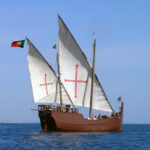
Fast forward to 2020! Entrepreneurial spirits took advantage of the COVID-19 lockdown to extricate five hundred metres of copper cable from the ground, leaving most of Redhouse cut off from the outside world for a week.
Unluckily for them, the copper price has crashed of late and when the scrap merchants open up, the robbers are in for a sad shock.
The gentle reader might be forgiven for assuming that the VOC title refers to the rivers of Very Old Cognac consumed over the years in Redhouse. But no, we have advanced to the age of the Vereenigde Oostindische Compagnie aka the Dutch East India Company.
After Vasco da Gama made it to India, the Portuguese had a hundred years of free travel around the Cape to the East Indies without any let or hindrance from pesky foreigners.
It’s true that Sir Frances Drake rounded the “fairest cape of them all” in 1580 during the first English circumnavigation of the planet, and some French ships had been to have a look, but in general the Portuguese enjoyed the monopoly granted them by the Treaty of Tordesillas signed in 1494 whereby they were allocated the eastern route and the Spanish got the west i.e. the Americas.
Further north, two contenders for sea power were stirring. The Dutch fought an eighty-year war to rid themselves of Spanish rule, and they did it mainly by building up a force of piratical sailors called the Sea Beggars who crippled Spanish trade to northern Europe.
Their fellow Protestants, the English, cared not a hoot for Iberian treaties and sent their own pirates to prey upon the new Spanish possessions in the Caribbean and the Americas.
These two emerging maritime nations occasionally came to blows. Mostly they were united against France and Spain, but sometimes politics intruded. They fought four wars over a period of about 130 years. The second war saw the introduction of the Line of Battle where ships sailed in disciplined rows a few hundred feet apart and cannonaded the hell out of each other.
The Four Day Battle occurred in the first week of June 1666. Eighty English ships versus one hundred Dutch. The Dutch decided to call it quits before day five began, but the cost to the Royal Navy in lives lost was not exceeded until the Battle of Jutland in 1916.
In due course, the Dutch and the English realised that there were enormous profits to be made out East, so they began to intrude on Portugal’s preserve.
They formed companies to fund each voyage. Normally, a small fleet of ships would be sent out and if and when they got back, the cargoes would be sold for up to fifteen times as much as they cost. The profit would be paid out to the shareholders and the company dissolved.
This high-risk adventuring evolved into the formation of the English Honourable East India Company in 1600 and the VOC two years later. These chartered companies held a monopoly in their own countries, thus ensuring great profits at much reduced risk.
The VOC was so well organised that it is recognised as the forerunner of modern multi-national corporates and its history is taught in business schools to this day. By 1669, it was the richest private company the world had ever seen, with over 150 merchant ships, 40 warships, 50,000 employees, a private army of 10,000 soldiers, and a dividend payment of 40% on the original investment.
Both companies did famously for a very long time but eventually lost the plot. From 1720 onwards the VOC began to decline and was dissolved in 1799, all its assets on land and sea being taken over by the Dutch government.
The English company grew into a massive organization. At the height of its power in 1803, its private army numbered 260,000, double the size of the British army. It ruled vast swathes of India. It was brought down by the Indian Rebellion of 1857 and the following year the British Government took control. It was finally dissolved in 1874.
Both these companies brought way more wealth to their respective homelands than did the Spanish and Portuguese royal monopolies. The reason should be blindingly obvious to the modern South African government. The Dutch and English model was based on free enterprise. The Iberian equivalents were state-owned enterprises. Whatever profits the latter made were squandered by the government.
That’s the inherent problem with tax. Those who spend the tax don’t have any idea how hard it is to generate it in the first place.
While the Portuguese were not interested in the Cape at all, the Dutch and the English recognised that it would serve as an ideal halfway house on the long and horrible voyages to the East, a place where fresh water and vegetables could restore to health crews devastated by scurvy.
There appears to be no cure for stupidity. It was recognised before 1600 that scurvy could easily be prevented by administering lemon juice to the ship’s crew and passengers once the fresh vegetables ran out. Certain skippers did this and kept the mortality rate down to reasonable figures.
But it took until 1795 before the Royal Navy made it mandatory to include lemon juice along with the daily grog issue.
Meanwhile, going to sea in an East Indiaman was a highly dangerous choice of lifestyle. It was normal to lose between one third and one half of the people. In one six-year period, of 5,228 soldiers who embarked at Lisbon, only 2,495 arrived in India.
It could take five months for an East Indiaman to reach the Cape. Some ships arrived there in such a disastrous state that the few remaining sailors couldn’t bring them to anchor, and relief crews had to row out from the shore to rescue them.
It is hard to imagine in this sanitised age what the tween-decks situation must have looked and smelt like after five months at sea with scurvy and dysentery raging. What did they do when the call of nature was urgent?
The captain had his own private loo. The crew shared the “heads” – so-called because the facility was situated in the bows or the head of the ship, which would normally be pointed more or less downwind.
Once upon a time I visited a replica of the Dutch East Indiaman “Amsterdam”, at the Maritime Museum in Darling Harbour, Sydney. I checked out the heads, out of interest, not necessity. I wondered how the lads wiped their hairy bums. Ropes extended down to the water, with the ends “fluffed out”. I gather you pulled up the rope when done and cleaned up. At least they didn’t have to horde loo paper. Imagine timing your bowel movement in sync with the waves crashing over the bow! Eish!
Jolly Jack Tar, a veteran sailor with a wooden pegleg, has the runs and desperately needs to get forward. It’s one bell in the middle watch – 30 minutes past midnight for you landlubbers – the wind is pumping 30 knots and the ship is close-hauled on the starboard tack – meaning the wind and consequently the sea is coming across the starboard bow, and the rain is driving sideways.
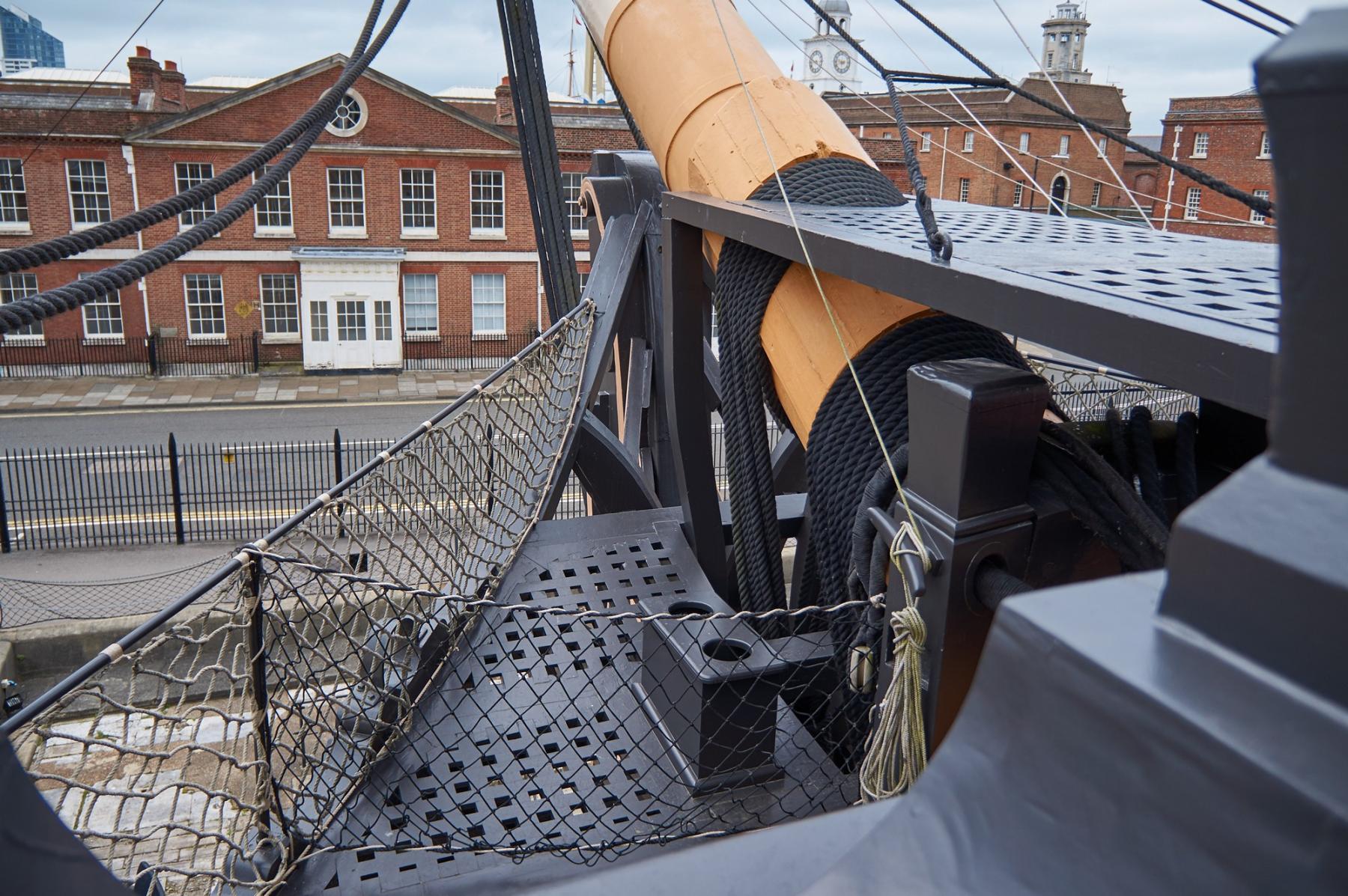
Observe the picture at the top of page one. Note the holes in the deck on the way to the seat of ease, designed to drain the water coming across the bows.
Jack stumbles forward in desperate haste, feeling his way in the pitch-black night, guts heaving, hold it in, hold it in, almost there, he gets a shock of spray full in the face and with that his pegleg goes down a drain hole! Now that’s kak luck!
There was no way for sick people to get to the heads, even in fine weather, let alone in rough seas. They lived and often expired in their own mess.
So now we know why the Dutch and the English wanted to secure the Cape as a place of refuge and replenishment. In 1615, the English conscripted a party of convicts headed by one Captain James Crosse, a notorious highwayman. They were given the choice between the gallows or the Cape.
They were landed on shore with some weapons, a few provisions and some turnip seed and told to make friends with one Goree, a Khoi chief who had previously been taken to India and taught English. Oh yes, and please establish a settlement while you’re at it. Captain Smythe summed up their chances and asked for a ship’s boat.
Once the fleet had departed, he rowed his band of baddies across to Robben Island which received the first of many consignments of prisoners onto its inhospitable shores, covered with guano and seabirds and apparently large numbers of mole snakes which grow to be two metres long. How did the snakes get there? Probable cut off from the mainland when the sea levels rose thousands of years ago, as they have evolved differently to the mainland variety.
Finally, Jan van Riebeeck started the Cape Colony in 1652, as we all well know. This didn’t bother the Brits as even in wartime the Dutch allowed them to land and recover. Scurvy and the sea were the common enemies, so it was live and let live and pass that excellent Cape brandy.
The Dutch and later arrivals such as the French Huguenots eventually expanded out of the original bounds of the Cape Colony. The further away from Cape Town they travelled, the more they morphed into the “trekboeren”. They lost most of the vestiges of civilization and travelled ever eastwards in their ox wagons, living off the large herds of buck available in those days. They grew into a tough and independent race. All they really needed from Cape Town was ammunition.
In 1702 a well organised party travelled to the Fish River where they encountered the AmaXhosa. This is recorded as the first encounter between the races, but someone knew the way. Plenty of shipwrecked sailors had walked the shores over the centuries. Quite a few had been absorbed into local tribes.
The AbeLungu clan has proven to be descended from white forbears via DNA testing. Even more fascinating are the AmaMolo. Oral history claims they arrived in strange ships, dressed in long white robes, a long time before any whites came along. Their DNA points to an Indian origin. All they could say was “Molo”, the Xhosa greeting, and the name stuck. Both clans live along the Wild Coast.
Getting closer to home, who lived along the Swartkops River at the beginning of the 1700s?
The AmaGqunukhwebe – try saying that without hurting you tongue, mlungu! – is a tribe created by King Tshiwo, paramount Chief of the Ama Xhosa from 1670–1702 from the remnants of Khoikhoi tribes such as the Gonaqua, Hoengeniqua, Inqua and others retreating before the trekboers advancing from the west. They inhabited the land between the Qonce (Buffalo) and Qhagqiwa (Swartkops) rivers, but there is no evidence that they took up residence in our future Village.
When the Village Hall still served as a primary school, many decades ago, I remember that behind the hall there was a crude hut inhabited by an old crone we called Witchy. We were suitably scared of her. What her origins were I know not, but she looked old enough to have been around for a couple of centuries.
Now that you are bored stupid by all this history, let me tell you that we are on the brink of exciting times, where history comes to Redhouse! Hang in there, lockdown is nearly over!