If you read the first episode of this saga, you will remember our man !Click, who may have been done to death by the Phoenicians. Surely, the sceptic asks, isn’t it far more likely that the Khoikhoi did him in? After all, the former hung about for a couple of months, whereas the latter had fifteen hundred years in which to lose their cool with !Click.
I don’t think so. If there had been an altercation, the victorious Khoikhoi would have been left in possession of their encampment on the site of the future ZRC bowling green, the San would have fled, and the victors would have chucked !Click’s body into the River to get rid of the evidence, a custom I can tell you is honoured to this day.
Back to the first millennium of the Christian era. While Europe lived through its dreadful Dark Age, the happy fellows down south continued their blissful existence in the sun, generation after generation, pass the Karri, no worries mate, as those aboriginals say on that hot continent this side of New Zealand.
Eventually, someone turned the lights on, and the Dark Ages passed. What kickstarted the process, in my humble opinion, was the balance of trade. The people of Europe, whose main contribution to civilization for the past many hundred years had been constant warfare and the odd magnificent cathedral, became aware that the people to the east of them enjoyed a much higher standard of living.
Everything they heard from the ships arriving from the Eastern Mediterranean sounded too good to be true. Fine clothes, smart houses, exotic foods, a wide variety of wines, the list went on and on.
They wanted some too. But how to pay for it?
Picture the scene. The lady of the manor, barefoot and possibly pregnant in the kitchen, such as it is, dressed in a sackcloth nightie (I am not sure what sackcloth is, but it sounds suitably unfashionable), is unhappy.
She has heard about the wonders of the East and how comfortable life is in Baghdad for highborn ladies. It’s time for change, she decides.
At this moment, in staggers the Lord of the Manor, having just sent a couple of unruly serfs to everlasting hell and damnation. He is accompanied by his young squire and two burly men-at-arms, Tom and Bert.
She lets the sackcloth slip off the shoulder exposing rather more skin than a young squire should see, causing his youthful eyes to open very wide indeed.
“Darling, I want to talk to you alone”, says she, in the sultriest of Norman French tones.
Now you must remember his Lordship is wearing full armour. This consists of a surprisingly large number of separate items. This guy is wearing enough steel to stock a small automotive component manufacturing plant.
It’s easy to lift the large helmet off his sweaty head and toss it aside. But then we have the gorget (neck guard), spaulders (shoulder guards), vambraces and gauntlets (arms and hands), cuirass pieces (chest and back), cuisses, poleyns and greaves (thighs, knees and shins) and sollerets (segmented feet guards).
While his henchmen work frantically to dismantle the metal assembly, the Baron’s lusty gaze never leaves his delectable wife. If you have ever seen a bull elephant in must, you can imagine the heat of the moment.
“Hey, Bert, pass that number 15 spanner!” shouts Tom.
“Ok, but I need the Phillips screwdriver” replies Bert.
Just one item left and then she’s in for it.
“Dog’s bollocks!” wails Bert “we didn’t bring the Allan keys for his codpiece!”
Let’s leave that there.
The message was clear. You want nice, then produce the silk and spice! So now you understand that the sudden emergence of Europe from the Dark Ages was based on nothing more than feminine retail therapy.
In order to pay for these goodies, gold was required. There wasn’t a lot in Europe, but there was a steady supply coming across the Sahara via camel train from deepest, darkest Africa.
This bullion was handled by the Ottoman states ranged across the coast of North Africa. But, as Christian Europe was perpetually at war with the Muslims, not much gold crossed the Mediterranean Sea.
Enter Portugal. Specifically King John I and his English bride, Queen Philippa, elder sister of King Henry IV of England.
Portugal and England are joint signatories to a treaty signed in 1373, which has never been revoked. For nearly six hundred and fifty years, they have been allies in numerous wars. This longstanding friendship is no doubt strongly reinforced by the English passion for Vinho do Porto.
The royal couple produced a fine batch of princes, called the “Illustrious Generation“. These guys led Portugal into its famous age of discovery.
One of them was Prince Henry the Navigator. He masterminded the slow but steady exploration of the west African coast and its offshore islands, the Canaries, Madeira and the Azores. The objective was to find the source of that African gold.
In 1412 he ordered an expedition to sail down the coast of Africa. From that time on, every couple of years, the Portuguese explorers reached a new point further south. In 1471 they crossed the Equator. The southern hemisphere was discovered, and they started using the Southern Cross for night time navigation.
Finally, in 1488, after fifty years of methodical exploration, Bartolomeu Diaz and his reluctant crew beat into a south westerly breeze, losing sight of land. They turned east, and when no land appeared, they altered course to port and eventually spotted the coast just west of present day Mossel Bay. The Khoikhoi clan in residence took one look at this apparition on the sea and fled inland with their cattle.
Diaz sailed into Mossel Bay. The sailors landed, found fresh water and began to fill their barrels. The locals didn’t run away, but they were clearly unhappy. Eventually they began to throw stones. Standard South African protest action. Grabbing a crossbow, Dias shot one of them dead, causing the protestors to flee in terror. Standard South African security force reaction.
Thus, this initial contact between the first Europeans to reach southern Africa and the Khoikhoi resident in the future Mossel Bay was to set the scene for the next several hundred years.
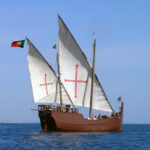
Over the years of exploration, the Portuguese had constantly improved their ships. Still, Senhor Diaz’s caravels would probably not be allowed at sea if governed by modern day South African rules, generated by that dubious organization, SAMSA, whose mission statement appears to be “if it floats, tax it!”.
In 1988, a replica caravel was sailed from Portugal to South Africa, eventually ending up in a museum in Mossel Bay. It visited Port Elizabeth and I attended a cocktail party on board. Attending cocktail parties on ships was a favourite pastime in those days.
In spite of the flush loo, modern navigational equipment and a sturdy diesel engine, the captain said he would be most reluctant to sail her up the Wild Coast.
Five hundred years before, Bartolomeu and crew sailed eastward and entered what we now call Algoa Bay. They anchored in the lee of an island they named Islet of the Cross, now called St Croix, upon which they erected, of course, a wooden cross.
Diaz had started the voyage with four black female slaves, who had been abducted from somewhere on the west coast of Africa by a previous expedition, taught the language and educated in Christianity. The plan was to drop them off at various places where they would teach the local inhabitants about the glories of Portugal.
One died at sea, two got dropped off somewhere on the west coast, and the last was marooned on the shores of Algoa Bay, near some Strandlopers collecting shellfish. What did they expect would happen to this poor soul? Needless to say, that’s the last we hear of her.
At this point, let me tell you that the Portuguese sailed backwards and forwards past the coast of South Africa forever, without showing the slightest interest in going ashore unless they really had to.
So uninterested were they in the country, it took them until 1575 to produce the first chart of the South African coastline.
They regarded the place as a wilderness and the inhabitants as bloody dangerous, understandably so as they lost the Battle of Salt River by badly underestimating the fighting ability of the local Khoikhoi tribe, the Gorinhaiqua.
On his way home from India in 1510, the notorious Francisco D’Almeida, an experienced soldier with a brutal reputation, stopped off at the Cape for water. He decided to attack the Gorinhaiqua encampment and attempted to take cattle, women and children.
In their arrogance, the Portuguese didn’t bother with firearms. But their swords were no match for the Khoikhoi spears, let alone their war cattle, which were trained to respond to their masters’ whistles. The cattle completed the rout. D’Almeida and over fifty sailors died.
A few years back, a severe storm exposed a mass grave near Woodstock. Archaeologists identified D’Ameida’s bones. First round to the Khoikhoi.
Over the centuries, Portuguese ships must have stopped off in Algoa Bay to replenish their water casks. But there is no evidence that they ever sailed very far up the River.
I am sure that if the grounds of the ZRC were dug up, plenty of empty port bottles would be discovered, but they wouldn’t have come from a caravel.
The Khoikhoi settlement on the banks of the River was no more. They had moved on. !Click rested in his grave. All was quiet.
The future site of Redhouse was deserted. Nothing was heard but the lapping of the water against the banks, the lovely call of the fish eagle, and of course, the maddening chitter-chitter of the verdomde egrets!
Talking about charts, if you look at websites dedicated to Algoa Bay and Port Elizabeth, you will see that some of them include a map. It states that it is a late seventeenth century chart of Algoa Bay.
I magnified it and it didn’t look right to me, so I investigated further. It turned out to be a Dutch East India Company chart of Delagoa Bay! Nice one, web site designers!
Wondering where all our tourists went? Try Maputo!
Another delightful read!
Click would like to know what or where his codpiece is?
The Codpiece covered the family jewels!