A Lost Civilization

Twenty Thousand Years in Twenty Minutes

Twenty thousand years is a tiny sliver in the 4.54-billion-year history of Planet Earth. Nevertheless, this period has not been short of drama — and nowhere is that more apparent than in the ancient mysteries and lost civilization that the archaeology of the last ice age is slowly bringing to light.

It does not even account for a particularly large chunk of human history. In fact, the oldest securely dated fossils of Homo sapiens sapiens are from Morocco and are 315,000 years old, and it is almost certain that anatomically modern humans were around before that.

The World That Was Lost

The Last Glacial Maximum (LGM) — when the globe was weighed down beneath kilometre-deep ice in the northern hemisphere and sea level was at least 130 metres lower than today — hit its peak about 20,000 years before the present (BP).

Then the world began to warm up, rapidly. As a result, the sea rose steadily — or perhaps in fits and starts — and coastal plateaus with an area equal to that of the North American continent began to go under. This enormous area was undoubtedly home to human beings and all manner of wild animals, and who knows what lost civilization.

The losses were staggering:

  • The vast continental shelves off the east coast of North America and the Gulf of Mexico were flooded by 15,000 BP.
  • Beringia — a one-million-km² land bridge to America at the eastern end of the Asian landmass — was under water by 11,000 BP.
  • Doggerland, an inhabited area of about half a million km² joining what are now the British Isles to northwest Europe, was slowly inundated. The final act was devastating: a massive submarine landslide off Norway triggered the Storegga Tsunami, estimated at up to 20 metres high, which swept over the remaining low-lying areas and probably wiped out most of the remaining population. Doggerland is thought to have been abandoned by 8,000 BP. Fishing boats occasionally still pull up skeletal remains of humans and their artifacts — over 2,000 objects are on display in museums. There is much evidence of lost civilization.
  • Sahul — the Australian mainland, New Guinea, Tasmania, and many smaller islands — similarly saw over two million km² inundated by 8,000 BP.
  • About 7,600 BP, the Mediterranean Sea broke through the Bosporus and transformed the landscape around a small freshwater lake into the Black Sea.
  • Sundaland — Borneo, Sumatra, Java, and the Malay Peninsula — lost another 1.8 million km² to the sea by 7,000 BP.
  • At the LGM, the entire Persian Gulf basin was a fertile area of 240,000 km², fed by the combined Tigris, Euphrates, Karun, and Wadi Batin rivers — sometimes called the “Arabian Gulf Oasis.” It flooded progressively from around 12,000 years ago, reaching its present configuration about 6,000 years ago.
  • Closer to home, the Agulhas Bank — perhaps as much as 250,000 km², stretching up to 200 km from the present South African coastline — was under water by 6,000 BP.

The Green Sahara — a Lost Civilization

Apart from the general inundation of such vast areas of land, climatic changes were equally dramatic. The African Humid Period started about 14,800 years BP, when the monsoons moved north and “greened” North Africa.

The process was briefly shut down by the Younger Dryas event (12,900 to 11,700 years BP) — an icy interlude possibly caused by a meteor shower impact — but subsequently resumed from about 11,500 until 5,500 years BP. During this period, North Africa was a green paradise of savannah, forests, rivers, and lakes.

Then, quite suddenly, the climate changed again. In just a few generations, the region transformed into an arid desert, the wells dried up, and the people moved away.

When we speak of ancient mysteries and lost civilization, we need to consider the Sahara.

For 6,000 years, a lost civilization about which virtually nothing is known lived in this paradise. Then it vanished.

The Gap That Should Not Exist

Traditionally, “civilization” began 5,500 years BP with Sumer in Mesopotamia — a state, with cities and writing. Since then, we have evolved into a technologically advanced society of eight billion people.

This begs the question: if, in 5,500 years, humanity has achieved such advances — what was it doing for the 14,500 years between the LGM and Sumer? Furthermore, what was going on in the vast areas now under water? And in the vast, green North African expanse?

One could argue that the population was small to start with and needed time to reach the critical mass required for a sudden burst of technological advancement. However, that argument breaks down the more technology is brought to bear on the battlefield of archaeology.

Surely a lost civilization could have developed over 14,500 years?

Fourteen Mysteries That Need an Answer

1. The Handbag / Bucket Motif

Identical images of a handbag or bucket, held in the right hand, appear across cultures with no known contact:

  • Sumerian/Akkadian relief carvings (~2500–600 BC) — held by winged beings attending a Tree of Life
  • Göbekli Tepe carved pillars (~9,600 BC)
  • Olmec stone carvings, Mexico (~1500–400 BC)
  • Tiwanaku/Puma Punku, Bolivia (~400–900 AD)
  • Ancient India — Vedic period carvings

In each case, the object is depicted with identical proportions, the same wrist-carry posture, and apparently the same internal structure — across cultures separated by oceans and millennia. Standard archaeology offers no satisfactory common ancestor.

2. Egyptian Core Drilling and Granite Precision

More than 4,500 years ago, the ancient Egyptians demonstrated technology that looks startlingly industrial. Granite drill cores recovered at Giza show a helical groove cut with a pitch of approximately 1 mm — meaning the drill advanced through solid granite at roughly 500 times the rate achievable with the hardest known ancient drill bits using sand as abrasive. Moreover, no ancient tool has ever been found that could produce this result, and modern diamond-tipped core drills cannot replicate the groove pattern.

Additionally, granite bowls and vases have been found with interiors machined to tolerances of fractions of a millimetre — including concave inner bases that no known ancient tool could reach. No items of this quality appear in the later Middle or New Kingdoms, suggesting the advanced technology of a lost civilization disappeared over time.

3. The Disputed Age of the Great Sphinx

Geologist Robert Schoch of Boston University has published peer-reviewed evidence that the deep vertical weathering patterns on the Sphinx enclosure walls are consistent with prolonged rainfall erosion — not wind and sand erosion. The last time the Giza plateau experienced sufficient rainfall to produce this weathering profile was approximately 9,000–12,000 BP – consequently placing the Sphinx’s original construction well before the Egyptian civilization that supposedly built it. What lost civilization was responsible?

4. Puma Punku, Bolivia — H-Blocks and Precision Andesite

The stones at Puma Punku are carved with geometric complexity that looks like modern CNC machining. Furthermore, the “H” blocks are apparently identical to one another, suggesting mass production or templating. Andesite is one of the hardest stones on earth, yet the cuts include internal right-angle channels, interlocking grooves, and surfaces flat to sub-millimetre tolerance. The site sits at 3,800 m altitude with no transitional earlier construction phases — it appears fully formed, with no precursor.

5. Baalbek — The Trilithon Stones

Three stone blocks in the platform of the Temple of Jupiter at Baalbek, Lebanon, each weighing approximately 800–1,000 tonnes, were quarried, transported roughly 1 km, and lifted into position at a height of 7 metres. In addition, a fourth block — the Stone of the Pregnant Woman — remains in the quarry at approximately 1,650 tonnes, the largest precisely cut stone block ever found. The standard explanation — sledges, ramps, massive labour — has never been demonstrated as physically achievable even with modern equipment. The blocks predate the Roman temple built on top of them; their original builders are unknown.

6. The Antikythera Mechanism

A complex clockwork device found in a shipwreck off Greece in 1901, it has over 30 bronze gears and was used to predict eclipses, track the movements of the sun, moon, and planets, and time the Olympic Games. Comparable mechanical complexity did not reappear in Europe until astronomical clocks of the 14th century. This is now largely accepted by mainstream archaeology as genuine — but what came before it? A device of this complexity implies centuries of mechanical tradition, none of which has survived. It cannot have appeared from nowhere. It seems obviously a product of a lost civilization.

7. Sacsayhuamán and Inca Polygonal Masonry

Massive stones — some exceeding 100 tonnes — fit together with joints so tight that a razor blade cannot pass between them. The polygonal shapes are not squares or rectangles but complex multi-sided irregular forms, each uniquely shaped to interlock with its neighbours in three dimensions. As a result, the walls survived earthquakes that destroyed Spanish colonial buildings built on top of them. The engineering principle is understood; however, the manufacturing process is not.

8. The Nazca Lines

Vast geoglyphs in the Peruvian desert — some extending for kilometres — are only fully visible from the air. The standard explanations — offerings to sky gods, processional paths, astronomical alignments — do not explain why precision visible only from altitude would be necessary to ground-level builders. Moreover, the designs include a spider found only deep in the Amazon, and a hummingbird, suggesting their creators had knowledge of regions far from the Nazca desert.

9. The Global Flood Myth

More than 200 independent cultures across every inhabited continent have a flood myth involving the near extinction of humanity, a vessel of survival, and the world being remade. The specific details — a hero warned in advance, animals saved, a bird sent to find land — are extraordinarily consistent across cultures with no known contact. The standard explanation that floods are common worldwide does not account for the shared narrative elements. Instead, the Younger Dryas and post-LGM inundation events provide a compelling alternative.

10. Ancient Astronomical Precision

The evidence of advanced knowledge is widespread:

  • Stonehenge is aligned to midsummer sunrise and midwinter sunset to tolerances requiring years of observation and a surveying methodology never identified.
  • The Pyramids at Giza are aligned to true north to within 3/60ths of a degree — more accurately than the Greenwich Observatory, which used modern instruments.
  • Newgrange in Ireland (~5,200 BP) is aligned so that sunlight enters a “lightbox” above the entrance and illuminates the inner chamber floor for exactly 17 minutes at dawn on the winter solstice. The engineering of the lightbox therefore implies precise astronomical knowledge.
  • Angkor Wat encodes the precession of the equinoxes in its dimensions.

11. The Dendera “Light Bulb” Reliefs

Relief carvings in the Hathor Temple at Dendera, Egypt, have been interpreted by some electrical engineers as depicting a Crookes tube — a primitive vacuum tube producing light. The image appears to include a filament, an insulating pillar, and a cable connecting to what looks like a power source. On that basis, Austrian electrical engineer Walter Garn constructed a working replica that produced a visible glow. Standard archaeology, however, interprets the images as lotus flowers and serpents with religious symbolism, and the experiment is dismissed by mainstream scholarship.

12. Damascus Steel and Greek Fire

Two ancient technologies whose formulas were lost and have never been satisfactorily reverse-engineered:

  • Damascus steel produced blades of extraordinary flexibility, sharpness, and visible crystalline patterning that modern metallurgy cannot fully replicate from contemporary accounts of the process.
  • Greek Fire, similarly, was an incendiary compound used by the Byzantine navy that burned on water and could not be extinguished with water. No surviving formula exists, and modern chemistry cannot identify a compound meeting all the described properties.

13. The Younger Dryas Impact and the Universal “Catastrophe Reset”

The evidence is striking and remarkably consistent:

  • A platinum/iridium spike appearing simultaneously at 50+ sites worldwide at 12,800 BP — including Wonderkrater in South Africa, Pilauco in Chile, and Abu Hureyra in Syria.
  • The simultaneous disappearance of the Clovis culture in North America.
  • The simultaneous megafaunal extinction across four continents.
  • The onset of the Younger Dryas cold period.
  • Universal global flood mythology.
  • The appearance of Göbekli Tepe immediately after the event (11,500 BP).

Taken together, the evidence suggests a catastrophe that destroyed an existing advanced civilization. Mainstream archaeology does not accept this hypothesis. It doesn’t help that whatever existed before 12,800 BP was largely destroyed and is now underwater on the drowned continental shelves.

14. Göbekli Tepe

This complex of carved megalithic enclosures in southern Turkey — dated to approximately 9,600 BC — demands a pre-existing tradition of complex social organisation, astronomical knowledge, and stone-working skill. It appears fully formed with no visible developmental sequence. Furthermore, it was deliberately buried around 10,000 BP by its builders or their descendants, under thousands of tons of rubble. No satisfactory explanation exists for why a community would entomb its most sacred site rather than simply abandon it.

A Lost Civilization — a Simple Conclusion

My simplistic view: from the LGM (20,000 BP) until the Younger Dryas event (12,800 BP), humanity produced an advanced civilization — vastly different to our version — spanning 7,000 years, which was abruptly destroyed by an unimaginable catastrophe. As a result, it took the survivors another 7,000 years to reach the point where they could start up the current version of civilization.

The new civilization inherited all the above examples of the older technology, but whatever knowledge it retained was gradually lost over time.

Someone built the pyramids in Egypt and in Central America. Someone machined granite to tolerances that challenge modern cutting tools. That lost civilization was wiped off the map, leaving vast monuments and stonework with no rational explanation in the mainstream archaeological record.

It seems quite easy to lose a civilization in one fell swoop.

Perhaps we should be more aware of what dangers lurk in outer space, or beneath the Earth’s surface — or just as possibly, within the minds of men.

To find out more on the topic of ancient civilizations, see this fascinating overview

St Patrick – History, Myths and the Real Story

St Patrick’s history is far more interesting than the popular legends suggest. Behind the shamrocks, parades, and stories of snakes lies the life of a fifth-century missionary whose influence shaped Irish Christianity and left a lasting mark on Irish identity.

Many a pint of Guinness will be raised around the world today in honour of St Patrick — and many more of Murphy’s best in County Cork.

But who was this man, whose name has become synonymous with Ireland itself?

Patrick came from western Britain — no one knows exactly where — around 385 AD, in the waning years of the Western Roman Empire. At the time, seafaring groups known to the Romans as the Scotti regularly raided the western coasts of Britain.

These raiders arrived without warning in currachs, small boats made from wooden frames covered with animal hide. They struck quickly, moving inland only as far as safety allowed, seizing captives and goods before retreating across the sea.

The Romans attempted to defend the coastline with a chain of forts, but when the legions withdrew in 410 AD, those defences collapsed. Raids intensified, and over time the Scotti established settlements across the Irish Sea — most notably the kingdom of Dál Riata, linking parts of modern-day Ireland and western Scotland.

Patrick grew up as the son of a minor Romano-British official. In his own account, the Confessio, he describes how a raiding party attacked his family’s estate at dawn. The raiders killed some and carried others off into captivity — including Patrick, then about sixteen years old.

St Patrick’s history – from Captivity to Calling

St Patrick’s history included six years in Ireland as a slave, tending livestock in harsh and isolated conditions. During this time, his faith deepened.

Eventually, he escaped and returned to Britain. There he entered the Church, became a priest, and later rose to the rank of bishop. Then, in 432 AD, he made a remarkable decision: he returned to Ireland — not as a captive, but as a missionary.

Patrick describes a vision in which a man named Victoricus brings him letters from Ireland, while voices from the western shores call him back. Driven by this sense of divine compulsion, he returns — though not without doubt.

His mission focused largely on the regions of Connacht and Ulster. Tradition holds that he spent forty days fasting on Croagh Patrick in County Mayo.

He founded his first church at Saul in County Down, on land given to him by a local chief named Dichu. The building itself was a barn — sabhall in Irish, or scioból in modern usage.

Patrick’s work was not easy. Local rulers resisted what they saw as a foreign and destabilising influence.

The Druids, custodians of traditional belief systems, opposed him directly. At one point captors held him for sixty days, and he survived several attempts on his life.

Even back in Britain, critics accused him of misconduct in his earlier years.

Yet Patrick understood the structure of Irish society. Power lay with the tribal chiefs. By converting them, he often secured the allegiance of entire communities.

Over time, he ordained priests and bishops, laying the foundations of a church that endured and expanded long after his death.

He died around 461 AD, and tradition places his burial at Downpatrick.

St Patrick’s history – Myths and Misconceptions

St Patrick’s history includes many familiar legends — but history tells a different story.

  • He was not the first Christian in Ireland. A missionary named Palladius arrived the year before Patrick, sent to minister to existing Christian communities.
  • He did not drive snakes out of Ireland. Ireland had no native snakes after the last Ice Age — the climate saw to that long before Patrick arrived.
  • He did not use the shamrock to explain the Trinity. That story only emerged in the 18th century, over a millennium after his lifetime.
  • He was never formally canonised. The formal canonisation process began centuries later. The Church recognises Patrick as a saint through long-standing veneration, and his feast day falls on 17 March.

The Real Legacy of St Patrick

Strip away the mythology, and what remains is arguably more compelling.

Patrick was not simply a symbol, but a catalyst. Within a century of his death, Ireland underwent a profound transformation — from a pagan, tribal society to one of the most influential centres of Christian learning in Europe.

His legacy lies not in legend, but in that transformation.

So by all means, raise a glass today — but perhaps also take a moment to remember the man behind the story.

Artwork representing St Patrick's history and legend

The Slave Trade: The Myths We Prefer Not to Question

THE SLAVE TRADE: UNCOMFORTABLE TRUTHS, THEN AND NOW

In my historical novel, The Boys from Umgazana (https://frankcollierauthor.com/), the slave trade appears largely in passing.

While researching the broader historical backdrop, I realised how shallow my own understanding of the slave trade had been.

Like many people, I assumed the issue had been settled long ago — neatly wrapped up when Britain abolished the slave trade in 1807.

That belief is wrong. Seriously wrong.

Slavery did not end. It sanitised its name. Today, we call it human trafficking.

Slavery predates recorded history and has existed in almost every civilisation known to man.

This article focuses on slavery in Africa because Africa sits at the centre of several of the world’s largest and longest-running slave systems.


THE SLAVE TRADE – THE IMAGE WE PREFER TO REMEMBER

In the modern Western imagination, slavery has become almost synonymous with the transatlantic slave trade:

Black Africans packed into the holds of ships, crossing the Atlantic in conditions so brutal that many never survived the journey.

The villains seem obvious: European ship owners, brutal captains, sadistic plantation owners, and overseers armed with whips and dogs.

From the mid-eighteenth century onward, abolitionists rightly condemned these men and eventually forced Britain to deploy the Royal Navy to hunt down slave ships across the Atlantic.

However, this familiar story focuses almost entirely on the final two links in the slave supply chain: the transporters and the buyers.

It rarely examines the first link.


WHO SOLD THE SLAVES?

Slavery in Africa did not begin with Europeans.

For centuries before the first Atlantic slaver sailed, traders exported human beings from Africa:

Northwards across the Sahara to North Africa and the Mediterranean.
Eastwards through the Red Sea and the Indian Ocean.
And later, westwards across the Atlantic.

The numbers remain staggering, even when historians use conservative estimates.

Between 700 and 1900 AD, traders sold roughly 12 million Africans through trans-Saharan, Red Sea, and Indian Ocean routes — an average of 10,000 people per year.

Between 1500 and 1900 AD, traders shipped a similar number across the Atlantic — closer to 30,000 per year.

During the eighteenth century alone, slave traders removed 6.5 million people from sub-Saharan Africa — about 12.5 percent of the population at the time.

These figures exclude the countless deaths caused by forced marches through jungles and deserts, as well as the bodies dumped overboard during ocean crossings.

Astonishingly, most enslaved Africans never left Africa.

Here lies the uncomfortable truth.


SLAVERY WAS NOT A ONE-WAY TRADE

So who supplied the slaves?

The answer remains unavoidable. African tribal chiefs and elites did.

They captured, sold, and traded other Africans through long-established systems of warfare, tribute, and commerce.

Why does no one condemn these so-called sacred ancestors?


THE BARBARY STATES AND THE SLAVE TRADE

While traders sold Africans to the south, east, and west, in the northern hemisphere Europeans were the target.

From the sixteenth to the early nineteenth century, pirates and slavers operating from the Barbary states — modern Morocco, Algeria, Tunisia, and Libya — captured an estimated one to one-and-a-half million Europeans.

These victims were not only sailors and fishermen.

They included farmers, women, and children dragged from coastal towns in Italy, Spain, France, England, Ireland, and even Iceland.


THE SACK OF BALTIMORE, 1631

In June 1631, raiders emptied the small Irish town of Baltimore in County Cork.

Barbary corsairs led by a Dutch renegade, Jan Janszoon — better known as Murat Reis — arrived under cover of darkness.

More than two hundred armed men crept ashore.

They torched houses.

Terrified inhabitants fled their beds.

Within minutes, the raiders forced over 200 men, women, and children onto ships and carried them to the slave markets of Algiers.

Only two or three ever returned to Ireland.

The captives faced a grim fate: galley slavery for the men and sexual slavery for the women.


ENDING THE BARBARY SLAVE TRADE

After the Napoleonic Wars, the American Navy — followed by British and Dutch forces — attacked Algiers and freed many captives.

Moral arguments failed.

Naval gunfire succeeded.

However, slavery in North Africa only ended decisively in 1830, when France invaded Algeria and dismantled the system by force.


MODERN SLAVERY: THE TRADE CONTINUES

Fast-forward to the present.

According to the International Labour Organization, between 45 and 50 million people worldwide live under conditions of slavery.

Modern slavery includes forced labour, debt bondage, forced marriage, human trafficking, sexual exploitation, and the sale of children.

The defining feature remains simple: the removal of choice — the inability to walk away.

In South Africa alone, the Global Slavery Index estimates that around 158,000 people lived in modern slavery in 2021.

Strong evidence suggests that the problem persists — and continues to grow.


SO WHAT IS BEING DONE?

South Africa, like many countries, has strong laws on paper.

In practice, authorities enforce them weakly, inconsistently, and often corruptly.

Political interference and institutional incompetence cripple the machinery of justice.

Slavery, like many other forms of crime, flourishes where consequences disappear.

And it will continue until voters install an honest and competent government.

The good news is that we have local government elections later this year!

There is a famous quote: “In a democracy, the people get the government they deserve”.

I think we deserve better than the current sorry lot!

Make sure your show up and vote!

Ancient African Cities!

Ancient African Cities You’ve Probably Never Heard Of

Many ancient African cities shaped trade, culture, and learning long before European arrival. For another African history story with deep local roots, see The Boys From Umgazana

When I started researching ancient African cities, I realised how incomplete my early view of Africa had been.

Like many people, I once pictured pre-colonial sub-Saharan Africa as vast wilderness: endless savannahs, dense forests, great rivers, abundant wildlife, and small, scattered communities living much as they always had.

What I did not picture were cities.

Yet long before Europeans built Maputo or Cape Town, Africa supported large, complex urban centres, many with tens of thousands of inhabitants.

Early Cities Across Africa

In Nigeria, the people of Nok produced terracotta sculptures and worked iron as early as 1500 BC. Archaeologists believe these communities lived in sizeable towns of up to 15,000 people.

In Sudan, Napata became the capital of the Kingdom of Kush around 800 BC and even ruled Egypt for a time. Its later capital, Meroë, featured pyramids, iron industries, its own writing system, and a population that may have reached 50,000.

Further west, Djenné-Djenno in Mali thrived as a major trading centre until about 900 AD, while Kumbi Saleh likely served as the capital of the early Ghana Empire, built on the gold trade.

Timbuktu, also in Mali, boasted as many as 80,000 people and had libraries and universities, besides controlling trans-Saharan trade routes.

Trading Cities and Coastal Ports

By 800 AD, Gao on the Niger River had become a key trading city with around 25,000 residents.

Along the East African coast, Kilwa Kisiwani prospered through Indian Ocean trade and even minted gold coins before the Portuguese destroyed it in 1505. Mombasa followed a similar path, handling long-distance trade with the Islamic world and already housing 25,000 people by 900 AD.

Southern Africa’s Forgotten Cities

Closer to home, Mapungubwe in South Africa emerged around 900 AD. Its people exported gold and ivory through coastal ports and left behind remarkable gold artefacts.

Ancient African Cities

Further north, builders constructed Great Zimbabwe around 1100 AD, creating the largest dry-stone complex in sub-Saharan Africa and supporting a population of up to 20,000.

On the Swahili coast, Lamu and Sofala also flourished as trading towns, linking southern Africa to the wider Indian Ocean world.

Rethinking Africa’s Past

Africa’s past includes far more than wilderness and tribal life. For centuries, ancient African cities supported trade, learning, industry, and sophisticated societies.

Now to visit them!

But not before I have written the sequel to The Boys From Umgazana.

The Castle of Good Hope

The Castle of Good Hope

South Africa is not a great destination for castle enthusiasts. However, what we do have are forts. The Castle of Good Hope is a bastion fort.

Its predecessor, the Fort de Goede Hoop, was built in 1652 and now lies beneath the Grand Parade.

Hout Bay has the East Fort and the West Fort, gun batteries built by the Dutch and French in the late eighteenth century to discourage British ambitions. The remains of the Amsterdam Battery lie mostly buried beneath the V&A Waterfront in Cape Town.

Simon’s Town has a Martello Tower, one of about two hundred built by the British during the Napoleonic Wars.

Port Elizabeth has Fort Frederick, built in 1799 by the British to protect the landing place. Nevertheless, it has never been attacked by anything more dangerous than vagrants.

A Brief Military Detour to the Castle of Good Hope

I have a story about the Castle of Good Hope.

In 1965, I served as a conscript in what was then the 2nd Armoured Car Regiment, now the School of Armour. The base lay in Tempe, Bloemfontein.

For reasons I still do not understand, every year a troop of very happy soldiers left our Free State hell camp and travelled to Cape Town on what amounted to a holiday.

After a very drunken train journey, we fell in on the platform and marched to the Castle. I remember pedestrians clapping as we passed, as if we were returning from the wars.

Cape Town did not appear to have many soldiers at the time. It did, however, have hundreds of ice cream vendors. We later learned that they belonged to the Navy.

Life in Castle of Good Hope

With so many sailors available, we wondered why tank troops had been sent to guard the disused Wingfield Air Force Base under naval command. Military intelligence, as they say, is the original oxymoron.

The Castle served as our base for six glorious weeks.

We ate meals off proper plates, served by waiters. No steel varkpanne appeared anywhere. We were amazed.

Our routine was simple. Two days on guard at Wingfield, followed by one day off. We could explore Cape Town during the day, but not at night. That rule proved easy to break.

My mate Gary and I owned civilian clothes. We slipped out through one of the small exits in the Castle walls, hid our uniforms in nearby bushes, and headed for Adderley Street.

The Biscuit Incident

One cold winter’s night, fog rolled in from the Atlantic. At Wingfield, one of our squad, a postman in civilian life, opened a large parcel of biscuits sent by his loving mother and began eating them.

When asked to share, he refused.

A plot followed.

While the others distracted him with loud complaints about selfishness, I went outside. I then leopard-crawled silently back into the guardroom and lunged for the bag of treats.

Postmen must develop a sixth sense for danger. As I reached for the biscuits, his large boot connected solidly with my face.

What followed was not pretty.

They threw him out into the cold, wet night. We devoured the biscuits. I went to sleep bruised but well fed.

Military Justice (of a Sort)

Some time later, a flashlight beam woke me. A large naval petty officer stood over me and said, “So you are the bully!”

The next morning, two things happened at parade.

One soldier, very drunk, fell over. A vodka bottle rolled out of his battledress. We had obtained the alcohol by bartering with locals through a hole in the fence around the airbase.

I was then marched into an office. Behind the desk sat a young veldtkornet (a lieutenant). In those days, the army had revived the ranks used by the Dutch East India Company.

An elderly corporal and the aggrieved postman stood nearby. Neither man would have set IQ records. They delivered long and mournful accounts of my alleged crimes.

I had, they claimed, committed assault and battery, stolen biscuits, deliberately jumped on eight army beds until they collapsed, and ridden the corporal’s bicycle into a wall.

As they spoke, visions of the dreaded DB (Detention Barracks) filled my mind. Rumour had it that few returned sane, if they returned at all.

Then I noticed the veldtkornet biting his lip to suppress laughter.

I received one week of confinement to barracks. No DB.

A Final Note

The Castle of Good Hope appears briefly in The Boys from Umgazana, mentioned in a previous blog – see https://onehundredandtwenty.com/?p=240.

You can read more at
https://frankcollierauthor.com/

If you have already read the book, I would enjoy hearing your thoughts. Email me at frank@frankcollierauthor.com
.

Castle of Good Hope
The entrance to the Castle of Good Hope, the old fortress in Cape Town, South Africa.

Newsletter #3 – The Redhouse Skeleton!

Several years ago, a surprising discovery shocked residents—the mysterious Redhouse skeleton was uncovered during trench digging along a busy street in Redhouse.

The excavation of the Redhouse Skeleton

Soon afterwards, their digger reached the electrical sub-station. At that moment, the bucket tore into the soil and exposed a seated skeleton with a round hole in its temple.

Immediately, the police arrived and declared a crime scene. Nevertheless, common sense soon prevailed because no villager would bury a victim beside such a busy road, even at night.

How old was the skeleton?

It would have been fascinating to determine the Redhouse skeleton’s age. After all, the railway line through Redhouse opened in 1875, and the famous Red House likely existed by 1850. Furthermore, growing activity followed the arrival of the 1820 settlers, by which time few Khoi clans remained intact.

The hole in the skull suggested a gunshot wound.

Therefore, we asked the police for forensic testing to date the bones. Interestingly, the Khoisan—formerly called Hottentots and Bushmen—sometimes buried their dead in a seated posture.

However, by March 2025 the SAPS Forensic Science Laboratory faced a backlog exceeding 140,000 cases. Consequently, I do not expect results soon.

So, what might have happened to this Redhouse skeleton?

Was he a war victim?

Redhouse skeleton

During the Third Frontier War, Khoi and Xhosa forces attacked the Star Fort near the Papenkuils River. They captured livestock and retreated toward present-day Kleinskool. Afterwards, they settled down to a celebratory braai, probably enjoying Karri, a fermented honey drink.

Meanwhile, the dragoons recovered their horses and followed the raiders’ trail. Eventually, they reached the braai, joined the gathering uninvited, and killed about forty people. Perhaps our skeleton was one of those casualties.

Alternatively, he may have been killed by passing sailors many years earlier. This Redhouse skeleton raised fascinating questions about the area’s early history.

Ultimately, we will probably never know.

Christmas shopping now looms. Therefore, consider buying a signed copy of The Boys from Umgazana for your favourite aunt. Each copy costs R325, plus courier charges when needed. Email me at frank@frankcollierauthor.com if you would like one!

You will find more information at https://frankcollierauthor.com/ or

https://jackandtemba.org/

For more stories about the Village of Redhouse, visit my Redhouse History page.

Shipwrecks!

Newsletter #2 – Shipwrecks!

Spoiler alert: The Boys from Umgazana includes a shipwreck!

The Wild Coast

More than two thousand ships have come to grief along the South African coast since the 1500s.

In May 1500, four Portuguese ships foundered in a storm off the Cape of Good Hope. Bartholomeu Dias, the first modern-era explorer to round the Cape, captained one of them.

Over the centuries, many famous wrecks entered South African maritime folklore. Their dramatic ends ensured they remained unforgettable.

– the São João (1552).
– the Nieuw Haarlem (1647).
– the Doddington (1755).
– the Grosvenor (1782).
– the Waratah (1909).

World War II

One lesser-known wreck recently forced its way back into public attention. Meanwhile, its story continues to unfold.

On 11 February 1943, U-boat U156 torpedoed the British merchant ship SS Helmspey about eleven miles off Cape St Francis. The ship carried a mixed cargo, including 1,457 tons of rubber bales.

Later, during a recent storm, thousands of these rubber bales broke free. They surfaced and washed ashore along beaches from Cape St Francis to Woody Cape, east of Port Elizabeth.

After more than 80 years underwater, the bales have begun to rot. Consequently, they now pose a danger to sea birds and other marine life.

Treasure Ship!

Shipwrecks don’t only produce debris — sometimes they harbour treasures. In fact, some carry astonishing wealth.

The richest wreck ever found, the San José, a Spanish galleon, sank near Cartagena in 1708 after a British attack. Her cargo includes an estimated US$17 billion in gold, silver, and emeralds. This excludes the priceless historical artifacts still aboard.

Search teams located the wreck 600 metres below the surface. However, its precise position remains a tightly guarded secret.

The Colombian government intends to raise the treasure. Nevertheless, multiple groups have filed competing claims.

These include the Spanish government, indigenous Bolivian communities, and a salvage company. Furthermore, modern-day fortune hunters have also taken interest.

A book as a Christmas gift?

If you’re still wondering what to give someone for Christmas, perhaps give them a book.

This is the link to The Boys from Umgazana:

https://frankcollierauthor.com

The Boys From Umgazana

The Blog Returns — After a long break, the blog is officially alive again to celebrate the launch of my historical adventure novel, The Boys From Umgazana.

Read all about it on my author website: frankcollierauthor.com or visit the dedicated book site: jackandtemba.org.

You can also subscribe on my author site to receive these updates directly.


What The Boys From Umgazana Is About

Set in the rugged wilderness of 18th-century South Africa, the story follows two boys—one English, shipwrecked and orphaned, the other born of both Mpondo royalty and English heritage—who grow up as brothers.

Their world changes when a Dutch trader arrives, pulling them into the turbulent landscape of early 19th-century frontier South Africa, where courage, loyalty, and identity are forged in fire.

The Boys From Umgazana blends adventure, cultural collision, and the power of place into a sweeping historical tale with timeless relevance.


The Boys From Umgazana launches at the Zwartkops Rowing Club

The novel launched on 8 August 2025 at the infamous Zwartkops Rowing Club—fuelled by a festive flood of alcohol that almost certainly helped boost sales among the cheerful crowd.

Aftermath of The Boys From Umgazana book launch at Zwartkops Rowing Club

A week later, I left for Ireland, Italy, and the Gulf of Bonifacio—leaving behind several administrative boxes spectacularly unticked.


They Printed the Wrong Version of The Boys From Umgazana … And Eagle-Eyed Readers Noticed

It didn’t take long for sharp-eyed readers to message me about mistakes—most notably “1982” instead of “1782.”

The culprit? The wrong version had been printed and uploaded.

The correct edition is now live on Amazon, Takealot and all international platforms.


Writing The Boys From Umgazana Was Only Half the Work…

Finishing a novel is only Step One. Step Two is introducing it to several billion unsuspecting readers.

I approached book marketing with enthusiasm—initially. Then reality intervened. When the plumbing fails, I call a plumber. It’s not that I doubt my ability to fix a sewage problem… but my wife certainly does.

So, discussions with actual marketing professionals are now underway.


What’s Coming After The Boys From Umgazana

I am already writing the first of three sequels to The Boys From Umgazana.

I’m also planning three short documentaries that explore my adventures across the First World.

Comments—supportive, or otherwise—are welcome at frank@frankcollierauthor.com.

Visit the main site for more posts and updates.

Chronicles of Redhouse Release!

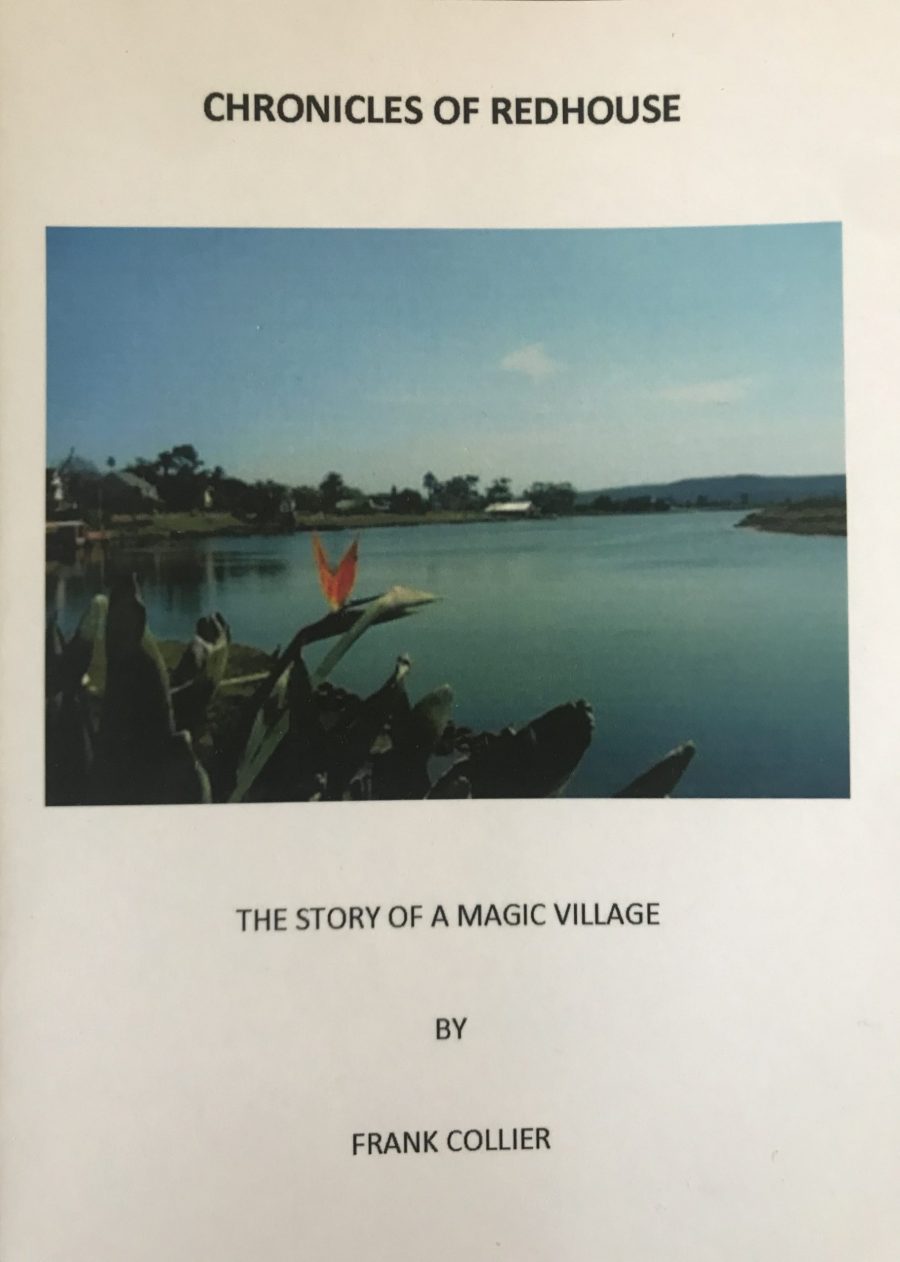
Hey Redhouse connections! The Chronicles of Redhouse are now available in one booklet!

We hope this not so serious look at the history of the Village makes it onto your Christmas present list!

R195 each, all proceeds to the Village Hall Fund to keep the Grand Old Lady in good shape.

Please place your orders with Pam Moore via email at moorepam9@gmail.com or phone her on 0838007097.

For out of town orders, courier charges will be for your account.

Redhouse Institutions

Wrapping up this series on the fantastical history of Redhouse, once known as the “Home of Jolly Bachelors”, we discuss the astonishing number of institutions which have played their part in the history of the Village, some long departed, others still going strong.

I should state that the reason for this series on the history of the Village is to record at least an outline of what transpired in this magic place. As the poet said, “The old order changeth, yielding place to new”. Generations come and go, and much knowledge is lost.

For future (and more serious) students of Village history, you need to know that the Redhouse Library is the repository of most of the records of the clubs and societies mentioned below. I am sure that diligent research in the dusty archives would reveal much new information to fill out these brief notes.

Curious readers may have wondered why this series has not concentrated on actual people of the Village, with very few exceptions. That’s because true history is sometimes best told as fiction, to avoid legal costs!

We start with sporting codes first.

Badminton

I have no idea when badminton began or ended or if it was run as a formal club. I do have very vague memories of games being played in the Village Hall. It was certainly going strong in the late 1940s and probably lasted into the 1960s.

The trophies for the modern Boxing Day Triathlon consist of the ancient and battered Badminton Cup minus one handle (First Prize) and the other handle (Second Prize).

Bowls

The Bowling Green was donated to the ZRC by Bill Oddy in 1953, which implies that it must have been in existence before that. In fact, close scrutiny of a photograph taking from the air in 1920 (I imagine the intrepid photographer leaning out of the back seat of a WW I Sopwith Camel biplane, hanging on to his heavy old-style camera for dear life) shows clear existence of what looks like a green in the correct position.

In the 1980s bowls became very popular and the ZRC Bowling Section joined the various local and national associations in 1984. To do this, they had to have 17 members. With time running out to get the application in, the late Gulla Reynolds approached members in the bar to please join up. I put my name down on condition that if I ever grew old enough to join the ”white ants” I would be allowed to play in Club colours, i.e. pink. Hasn’t happened yet!

The bowls section was renamed the Redhouse Bowls Club in 1997 and disbanded 2019, but social bowls remains.

Boxing Day Triathlon

This is a fairly recent tradition, started about 2008. It involves teams supposedly made up of at least two generations of the same family. The event takes place at the RYC and involves a swim across the River and back, whereupon the cyclists race two laps round the Village on the near side of the railway line, followed by runners who complete the event. Some surprisingly good times have been recorded.

Coffee and buns for competitors and spectators complete the morning and Christmas Dinner is well and truly settled.

Golf

The Redhouse Golf Club was founded in 1905. Emil Lippstreu laid out the course, which had greens of Kimberley Blue, a black grit. The course was looked after for most of its existence by George Goba, aided by his wife Maggie and his children, who acted as caddies in addition to looking after the family’s horses and cattle.

George grew up on my Grandfather’s farm, part of which is now the Wedgewood Gold Course. He ran the RGC, made the tea, took the green fees, checked the score cards and provided advice on how to negotiate the course.

Plenty of Village golfers learned to play on the old course and remember it fondly to this day.

In the 1970s the implementation of the Apartheid Group Areas Act meant that George had to move away. In addition, golfers were increasingly attracted to more modern courses in Port Elizabeth.

Salt pans were developed alongside the course and salt seepage put paid to the mushrooms which had been a feature well loved by the “owners” of jealously guarded patches. The Club was dissolved in 1978.

Hockey

There are photographs of the Redhouse Hockey Club dated 1905, so presumably it must have been started around that time.

At one stage, the field was situated on what is now a wetland opposite the Perseverance Industrial area. The field that I played on was situated a couple of hundred metres behind the primary school and was accessed from the first lane to the right when you entered the Village.

The field was notorious for its uneven surface which was caused by legions of moles who lived in that area. Eventually we were driven to planting broken glass in a trench around the field, but I don’t think it did any good.

The first clubhouse I remember was a wooden shack. It was replaced in due course by a fine brick structure, with showers, a braai and a bar.

During the 1970s and 80s the RHC fielded four teams and was unique in that it was multi-racial throughout the Apartheid era.

Many are the stories to be told about the good old RHC. One fine day the first team beat Uitenhage 7 goals to 2, which was a famous victory for us. The game started at 11h00. The last team members were carried out of the ZRC at 21h00 that night. It was a great celebration.

I claim to be the first streaker across the RHC field, when that was the fashion, but my achievement was surpassed by a certain Uitenhage player who happened to be under the shower after a hard, hot game when a Redhouse opponent threw a snake into his cubicle, knowing full well that the opposition player was petrified of serpents. With a startling scream he fled across the field stark naked except for soapsuds.

But, along with the collapse of civilization as we knew it, the RHC had folded by 1990, like so many other sports clubs.

Rowing

Rowing erupted onto the River in the 1870s with the formation of no less than four clubs, the Ino, Southern Cross, St Georges and the only survivor, the Zwartkops Rowing Club, formed in 1873.

The first regatta was held on 23rd May 1874, the ZRC resplendent in red, black and blue which preceded the familiar cerise “pinks” which have been the Club colours since at least 1895. In 1875 a regatta was held in honour of Queen Victoria’s birthday and included races for six-oars and four-oars, canoes and yachts, and ended with a “swimming match”!

Twenty-four years later the minutes of the 1898 AGM record a proposal by Mr Carden to sell off the racing boats as they were hardly ever used.

Rowing was dormant until 1973 when the massive celebrations planned for the ZRC Centenary saw a strong revival of the Club’s participation in provincial and national regattas. This burst of energy lasted at least forty years, with a number of male and female club members earning national colours.

The Village is also host to the Nelson Mandela University and Grey High School rowing clubs and of late, the Redhouse RC. The ZRC has recently signed up a group of Grey fathers who will hopefully write yet another chapter in the Club’s rowing saga.

Swimming

The Redhouse Swimming Club was founded in 1896, although I have a photograph of a large number of gents standing and seated in front of what must have been the first swimming club building, right on the riverbank, in 1895.

There are later pictures of the swimming jetty with a high diving board. The original wooden structure was replaced after WW II with brick changing rooms. Very convenient trysting hideout in the dead of the night for the young bloods.

The RSC won the inaugural River Mile race in 1924. Roy Gregory became the first River Mile Champion. 48 swimmers entered the race. Over the years, RSC won the event fourteen times.

Eventually, the event became commercialised and in 2010 was moved to the Sundays River due to perceived water quality issues.

For a short while in the 1970s if I remember correctly, there was an Enduro Race, swum from the River mouth to Redhouse, a distance of about seven kilometres.

Tennis

Tennis started in about 1918 when the Redhouse Tennis and Croquet Club was formed. All early minutes were lost when the house on the Henley property burnt down.

The Club boasted three gravel courts and a croquet court and a small clubhouse. Croquet had died out by 1930 but tennis was strongly supported. The courts were made “all-weather” and a fourth one built on the site of the croquet court during the 1960s. The aerial picture of the Village taken in 1920 shows cleared squares of land in the correct position.

The tennis fraternity had their own “Tennis Bar” at the ZRC where they gathered after the action on a Saturday afternoon, and very festive it was.

Yachting

The Redhouse Yacht Club has a long and interesting history which needs its own book. A brief precis follows.

The club was founded in 1904. A major celebration took place in 2004, capping a century of keen racing in a wide variety of craft ranging from forty-foot scows to small single-handed boats designed for children. As the area is well-known for strong winds, involuntary swimming is part of the sport.

Racing in the modern era is a lot less competitive than in the olden days, when the rules allowed a degree of mayhem that would instantly earn a red card in a rugby game today.

Many are the tales to be told of the countless races sailed since 1904. In these gentle days, gales are avoided. Not so in the past. The image remains in my mind of a Laser, running back from the Islands before a south-westerly buster, “pitchpoling” – the bow was driven under and she somersaulted. Crazy stuff!

Protest meetings were a regular feature. These are a form of court martial, run according to a strict procedure, where both sides get to tell their version of the incident under protest. I have witnessed many such trials and have always been amazed at how elusive truth can be.

The Clubhouse is situated in the floodplain so is invaded by the River and inundated with mud on a regular basis.  Work parties then have the joyous task of cleaning up.

One member who invariably swims when the floods come is “Mrs. Murphy”, the figurehead of a long-lost sailing ship. She moved from Veeplaas to the RYC in 1931 and has her make-up done on a regular basis.

In the big 1944 flood she was seen moving downstream in an upright and most stately manner (she has a heavy base, a feature shared by a lot of elderly women). In due course she was returned, muddy but unharmed, by railway truck.

In 1930 the wheelhouse of the tug “Ulundi” was set up on the end of the long-lost RYC jetty. The guns and the Ulundi’s bell (now on the Bridge) were housed there. Years later the jetty was removed, and the wheelhouse was carried upstream and set up opposite about where “A” buoy is moored, as an additional starting line. Eventually a flood carried it away. All that remains is the bell.

The RYC carries on sailing, long may it continue to do so.

Now we look at non-sporting activities.

Benevolent Society

In 1936 the ladies of the Village became concerned about the plight of the children who lived in the nearby township of Veeplaas. They collected 10 pence a month from each of the approximately 100 houses in the Village to buy milk and oranges for the kids. The “Benev” held its first committee in 1938 and carries on the good work to this day, although it is running very low on volunteers.

Carols by Candlelight

About mid-December, Christmas Carols are sung by a large group of people who move up the Towpath disturbing the dogs and ensuring that the numerous wicked in that part of the world are reminded that Christmas is coming and that they had better reform.

In the olden days, Carols were sung on Christmas Eve behind the Yacht Club. We had some very talented musicians and singers in the Village. The show was put together by Mrs Thelma Kohler. Good King Wenceslas was sung by Mrs Eily Murray and Mr George Jones, singing alternate verses, one falsetto, the other deep baritone, to the amusement of many naughty boys who, when they weren’t sticking their candles in some innocent’s ear, would do their best to mimic the singers.

One year, it rained. The Carol service was brought inside the Yacht Club building. The musicians were seated facing the River, and the congregation sat on rows of benches facing them.

Being Christmas Eve, many of us had watched Father Christmas come down the River and had thereafter observed the tradition of having one or two or eleventy toots at the ZRC bar. On this occasion, the Village Priest had joined us. He was a young bachelor, and very popular with his gentle congregation at St Nicholas, but was not well acquainted with the sailors who felt more at home on boats than pews.

The evil dogs plied him with liquor. Eventually he was escorted to the Yacht Club, where the Carol service was about to begin. Mrs Kohler thereupon summonsed the priest to say a prayer.

Well, he fell over several pews on the way to the front, then turned and faced the crowd and delivered the most slurred prayer ever heard. The old ladies of the Village were not amused. It wasn’t long before he was posted elsewhere. Fortunately, God relented, and we got him back again.

Cemetery

The graveyard must have been established after 1920 as there is no sign of it in the aerial photograph of that date. The first burial (north-west corner) was that of Mrs Munday, who ran a boarding house way back when at number 54 Towpath, the large house next to the ZRC.

Mrs Munday was succeeded by the indomitable Minnie Hutton, who has the lane next to the house named after her.

The cemetery covers a large enough area to have taken care of the Village for the next several millennia, but unfortunately the township funeral parlours discovered it and in no time at all it was filled up.

There were incidents of Satanists allegedly digging up corpses and headstones being pinched for rework by enterprising stonemasons, but nowadays it’s a deadly hush, excuse the pun.

Church

The Zwartkops Valley Land Company granted a site for the erection of a church on the west side of the Hall in 1939. World War II interrupted fundraising and building only started in 1952, the first service at St Nicholas being held on June 7th of the following year. The patron saint of children and of sailors, St Nicholas was an appropriate choice for a village with plenty of both!

I do recall the Bishop coming out from town to christen a batch of infants. Old Purple Pants had a lot to say about the young fathers who barely managed to crawl out of the River to attend the event. There was no noticeable increase in the congregation after that.

Father Christmas up the River

Each year since 1928 (perhaps even earlier) Father Christmas travels up-river by boat on Christmas Eve, with fairies to help him carry an enormous red bag full of presents for children of ten years and younger.

People come from far and wide to see the excitement as Father Christmas arrives blowing his horn and waving his ancient stick, while the fairies on board ring the bell. The children sing Jingle Bells and blow kisses to the fairies.

The remarkable thing is that the original Father Christmas, Alec Sharwood, was succeeded by his son John, so we have only had two in over 90 years.

In recent years, the landing place has been in front of the Yacht Club, but in the past he used to disembark at a jetty situated on the Village Green. Legend has it that one year some wicked people soaped the steps of the jetty, and Father Christmas slipped and fell on his guava in the River. I can well believe it.

Father Christmas departs to the sound of his horn and the ringing of the bell and the traditional trek to the ZRC bar takes place.

Floods

Floods are an irregular feature of Village life. There is a photograph from 1928 showing the Yacht Club well under water. Another happened in 1934 and a big one in 1944. I am sure there were others in between.

Within my memory, 1971 and 1983 were big floods, but on August 3rd, 2006 we suffered the mother of them all. Ten houses flooded on the Towpath. Carden Street became a parallel river, with people towing boats along the road filled with their belongings. I rescued folk from my house and pulled them in my blue boat Mr Bean to the railway line so they could escape to safety. The RYC sustained R350 000 in damages.

We last had a “normal” flood in 2011, followed by a minor visitation a year later which brought down the old retaining wall next to Toft’s Corner. I suspect that when the current drought breaks, we could have fun and games!

Hotel

I don’t know when the Sanatorium was built but it seems to have been in position when the 1920 aerial photograph was taken. The hotel was known as the “Sanny” and by all accounts was a popular establishment. Many ex-servicemen returning from WW II stayed there. And it was just a one-minute walk to the ZRC bar!

I have the menu for Christmas Dinner 1948. Whoever was there must have enjoyed the numerous courses available.

Library

The Redhouse Library started as a private book club run from the home of Mrs Bonnie Grylls,  situated on the Henley Property to the south of the ZRC. It burnt down in 1950. 600 books were lost.

The library then moved to the room attached to the Hall and was run from there until it moved to the old Valeyden shop in March 1968 when it became part of the PEM Library service.

In 1999 the PEM attempted to close down the Library, but the Village took it over, keeping half the books. Many more have been added since through donations from within the Village and without.  Mrs Rhona Clark and her band of volunteer librarians run the show.  They have been known to have wine on the premises, which I think should be encouraged as an aid to good literature.

Lippstreu Gardens

Mrs T V Paterson, a keen botanist who lived at 6 Deare Street, built in 1902, collected flora from the kloofs near Veeplaas and Bethelsdorp and laid out a garden in the remains of an old quarry where a dirt road led through two gates to a donkey camp. This is said to be where the original Red House stood.

She died in 1936 and the Lippstreu family took over and continued the good work. Eventually, the Park was taken over by the municipality, who contract out the work. I am not sure Mrs Paterson or the Lippstreus would approve.

Playschool

The Playschool was founded in about 1954 by the mothers of the Village and a building was erected within which generations of Village brats were introduced to education by a series of dedicated teachers.

Eventually the Village ran out of sufficient little children to keep the playschool going and it was taken over by the Primary School.

Post Office

When the telephone system was first introduced it ran on the old “party line” system. Our number was Redhouse 26. You would recognise your own ringtone. There was no privacy on the line. Mr Nicholls operated the exchange at the old Post Office in the ZRC flat on Stewart Avenue. He would know exactly where everyone was. It was a boon for gossipmongers.

The system was first introduced in the USA in 1878. A century later, modern technology began to take over but there are still 5000 subscribers in the remote parts of the States. In Australia, where distances are vast, they couldn’t always afford to put up telephone lines stretching across the endless Outback, so they sent the signal down conveniently placed barbed-wire fencing!

Railway Station and Bridge

In 1875, the railway line from Port Elizabeth to Uitenhage reached Redhouse. There is an ancient photograph of a steam engine straight out of a Wild West movie to prove the point.

As a small boy I was absolutely fascinated by the steam engines. I used to hang about the station as a four- year old, as we lived just opposite at 24 Deare Street. On the platform, the ancient gardener was boiling water for his afternoon tea in a tin can over a fire. I managed to knock this over, and the boiling water landed on my left foot.

The station master came running to see what the noise was about and poured blue ink over the burn. My foot was nursed back to health by Mrs Bleksley, a nursing sister who lived in Redhouse Road. Her brother-in-law was the famous Arthur Bleksley of “three Wise Men” fame for those who remember Springbok Radio.

Everybody caught the train to work and to school in those days, and as schoolboys we had much fun. These adventures need a blog of their own.

In 1947 the Blue Train steamed slowly through Redhouse so we could all wave at the Royal Family en route to Port Elizabeth. Fifty-two years later, we stood in Park Drive to watch the Queen drive by.

I don’t quite know when the Bridge over the railway line was built. It may have come about because a train took out poor, deaf old Mr Deare on his way to the Club.

Nowadays, we have the Great Train Race, where runners and cyclists race the train from Port Elizabeth to Uitenhage. It stops to take a breath at Redhouse for about 15 minutes and the passengers rush out to buy coffee and buns, while looking vainly for a place to pee. All the while the Pipe Band plays stirring tunes to stimulate the bladder.

Redhouse Improvement Klub

In 2011, the Ladies of the Village initiated a soiree at which the hostess for the evening collects the fee paid by each attendee. This gathering takes place on the second Thursday of each month.

The Gentlemen of the Village were not slow to respond to this opportunity. RIK was formed. The meetings are decidedly social events. Fees are invested and occasionally spent on useful projects to enhance the appearance of the Village. Members take turns as Quartermaster, supplying eats as blotting paper is essential at these gatherings.

The only downside is that Friday mornings are low on productivity.

Redhouse Primary School

As early as 1909 the school had 23 pupils from Sub A to Standard 7 (Grade 1 to Grade 9 in modern parlance). Miss Sadie McAdam was the principal and school was held in the Village Hall. In 1953 it moved temporarily to the Yacht Club while repairs were done to the Hall.

In those days, pupils came from Veeplaas as well as the Village.

Miss van Loggenberg was my teacher. She came in from Uitenhage by train. She was decidedly old school.  I remember her telling us that mankind would never travel to the Moon because it wasn’t God’s will.

The new building at the end of De Kock Street was first occupied in 1959 – I was one of four standard 5 pupils. There were really just a handful of us. Now the school has hundreds of pupils, mainly drawn from the Motherwell township.

Redhouse Ratepayers Association

The origins of the RRA are shrouded in the mists of time, when Redhouse fell within the jurisdiction of the Divisional Council.

In the 1960s the Village was incorporated in Port Elizabeth. Its dealings with the local authority have become more difficult over time as the present-day Nelson Mandela Municipality is a political shambles. Basic services keep going, but the general vacuum created by municipal paralysis will result in the RRA taking on more local governance. Which is a good thing. Why should citizens not run their own affairs wherever possible?

The Committee includes representatives from each quadrant of the Village, and it has a structure incorporating infrastructure, communications, security and planning.

And at least once a year the age-old tradition of debating what to do about the dreadful plague of egrets is upheld. These birds are a curse laid upon the Village by long-lost Khoisan witchdoctors, and I have no doubt they will be with us forever.

Redhouse Women’s Association

In 1904, the splendidly named Redhouse Women’s Vigilance Committee was established. It conjures up images of stern women standing at the back door of the ZRC waiting to drag their insensate husbands home.

In the 1970s they gave up that particular battle and renamed themselves the Redhouse Women’s Association. Read all about them under Village Hall.

Security patrols

Security duty has been a way of life since as long as I can remember. The vast majority of patrols were without incident but every so often we had some fun.

There was a time in the late 1960s when a determined burglar broke into the primary school on a regular basis. An ambush was set up one night in the line of pine trees on the school border. There a posse lay in wait for our friend to pitch up, which he duly did. The plan was to let him break into the building, then apprehend him.

At the critical moment, the guard commander and his 2IC, who had been enjoying a party at the ZRC, arrived noisily in their large Mercedes to check on the posse.

The burglar took to his heels through the bundu, pursued by a fusillade of bullets from a variety of firearms including my Army rifle. We never found the body.

At one time we had daylight security, provided by a series of dubious characters. One-legged Nick caught a very long cobra and stuck it in his bag while chatting away a little carelessly. The cobra bit his thumb.

Nick arrived at the hospital and was booked in. Of course, they don’t like firearms, so he was relieved of that, which took some filling in of forms. The patient was by now beginning to feel the effect of the venom, and they were about to rush him into the theatre when they noticed his bag and enquired about its contents. You can imagine the pandemonium when the irate cobra was revealed!

Septic tanks

I have always imagined that septic tanks were in operation from the time of the first houses being built. But it is only in the 1950s that they became a regular feature. Before that, a coloured gent called Roman operated the bucket system. He would collect them in his donkey cart. Where he deposited the contents remains a mystery.

Shops

We don’t have shops in the Village, for security reasons. But once upon a time we had three! The old hotel’s last gasp was a short-lived shop, there was for a time one at 14 Deare Street, but the original shop, run by the Valayden family from Veeplaas, was situated in the current library building.

I well remember being sent off to Sunday School as a small boy, clutching my “tickey” for collection. The temptation of a glass bottle of ice-cold Coca-Cola from Valayden’s fridge proved too much for me! A tickey was the equivalent of two and a half cents!

Village Hall

The wood and corrugated iron Hall was opened in 1911. The structure included a stage because Mr JC Carden had a keen interest in amateur theatricals.  The younger people insisted on a well-sprung floor for dancing. The building was lit by acetylene gas from a plant housed in a shed behind the Hall. In later years, an old crone called Witchy lived there. 

In 1912 the kitchen was added and after that came the veranda. In 1946 a flush toilet was built for the ladies which meant they didn’t have to bring their personal chamber pots to events.

In 1918 the Spanish Flu struck and two nursing sisters, Sarah Toft and a Mrs Arnold, set up a hospital in the Hall. They didn’t lose a single patient, no doubt due to the daily ration of champagne.

The magnificent doors to the Hall were donated by Mrs Toft in 1937. They originally came from the Royal Exchange in London, via the Standard Bank building in Port Elizabeth.

Ten years earlier, a pair of teak gates was erected as a memorial to the JO Paterson family who had come to live in Redhouse in 1902.

The Hall has been a Sunday school, a church and a chapel-of-rest prior to burial. It housed the Redhouse Primary School at one time and the Badminton Club. Dances, concerts, wedding receptions and adult education classes have all taken place within its precincts.

The building has a Conservation-worthy certificate and a citation from the Simon van der Stel Foundation.

I have many happy memories of happenings in the Hall. On one occasion, a Roman Orgy was held, and you had to go dressed accordingly. My outfit consisted of a helmet (the plastic insert from my Army “staaldak”) decorated with palm fronds secured with glue, somebody’s ballet tutu, and a Victorian cavalry sabre.

Entrance was via a colonnade of white columns. There were no tables and chairs set out, only mattresses on the floor.   You ate and drank in a prone position. I recall a large fellow flicking my sword into the wooden wall where it stuck quivering, no doubt to the consternation of the lady ghost who resides in the Hall.

I distinctly remember pouring red wine over the head of the fellow lying next to me, possibly to wake him up. Such delightful decadence!

Villager

The Villager is a monthly magazine which was started in 1966 and is still going strong. It was originally printed on an old Gestetner machine. It is a real treasure trove of local information and must form part of the keen student’s research. For many years it was managed by the late Nancy Goddard who had a knack for seeking out newcomers to the Village and ensuring that they were welcomed into the local scene.

Zwartkops Conservancy

The Zwartkops Trust (now Conservancy) was formed in 1968 to protect the River from a host of enemies including national, provincial and local authorities, commerce and industry, and the indigenous population.

Its activities include environmental education, litter picking, pollution spotting, harassing the council and much more. Have a look at www.zwartkopsconservancy.org for the full story.

Currently, the ZC is on a mission to restore water to the former salt pans across the River and to the north of Redhouse. This will bring back the thousands of birds who formally graced these dry and dusty pans, an essential step in the long process of securing international Ramsar Wetland status.

One project will see the freshwater which pours down the evil Motherwell Canal in prodigious volumes diverted from the River into the pans.

The ZC also has plans to build a barge upon which will be housed a large pump and a diesel motor. The barge will be towed to spots convenient for pumping salt water into the pans. The reason for a floating pump is security. The barge be will moored in the Village to protect it from the vandals who destroyed the land-based pumphouse and caused the salt company to cease operations.

It has been suggested that a 30 calibre Browning machine gun is a necessary accessory, good for the removal of gillnetters, hunting dog owners, ANC councillors and other riff-raff surplus to requirements.

Zwartkops Rowing Club

As previously recorded, the ZRC came into existence in 1873, the fourth of four rowing clubs founded around that time at Redhouse. It is the oldest surviving rowing club in South Africa. Without doubt, this ancient establishment needs its own more detailed history.

The club’s first building was a boathouse erected in a hurry to house the brand new four-oar arriving from England at a cost of £67 4s 8d, approximately £7333 or R164738  in today’s money. Which means that a quart of Windhoek Draught would have cost 22 cents in 1873!

The first clubhouse was rented from a member of the original committee, Mr Fred Levick, and was situated somewhere in the vicinity of 36 and 38 Towpath. In 1896 it was uprooted and re-erected in its present position. Several alterations have been carried out on the ancient structure and no doubt more will happen in the future.

Many hilarious tales could be told of Club life. There is a narrow exterior alleyway which runs along the length of the main bar and snooker room. Members frequently placed their beer glasses on the windowsill while playing their shots. On occasion, a teenage hand would appear through the window and stealthily remove a glass, returning it a few seconds later minus a good “sluk”. Eventually this was noticed, and the alarm raised but the miscreants always escaped.

The Centenary celebrations in 1973 involved a huge amount of preparation and the end result was a great success. One of the unplanned events was a gigantic rugby scrum which took place in the main bar, about fifteen members a side. Nobody died, surprisingly, but the carpet tiles were torn up and a piece of one distinguished member’s scalp was pinned to the bar like a Red Indian trophy for ages afterwards.

What’s next?

Well, that is the end of the series! For those who remember poor !Click from Episode One, I regret to say we are still waiting for DNA evidence to determine who was most likely to have killed him!

The entire series will shortly be available in book form, to be sold in aid of the Redhouse Women’s Association to assist the ladies in maintaining the Village Hall in the state to which the Grand Old Lady has become accustomed!

Should you be interested in purchasing a copy or two – think Christmas presents – please email me on frank@fcbs.co.za.